

A fairy garden is a real garden at a very small scale: living plants, a path that goes somewhere, and one or two props that make you look twice. It also happens to be one of the best ways to garden when all you have is a patio table, a balcony rail, or a sunny corner by the back door. This guide covers the containers, soil, plants and layouts that make a miniature garden last past the first month, plus eight ideas you can copy in an afternoon.
What you'll learn
- Which containers work (and why drainage matters more than looks)
- The soil, plants and scale rules that keep a mini garden from collapsing into a mess
- Eight fairy garden ideas for small spaces, from a single bowl to a window box
- A simple build sequence, watering routine and winter plan
- The few supplies that are genuinely worth buying
The short version
Use a shallow container with drainage holes, fill it with fresh container mix (not soil from the yard), and group plants that want the same light and water. Keep the plants small and slow, the props few, and leave open space for a path. Water when the top inch of mix feels dry, and pull cold-sensitive pots under cover before hard frost.
What makes a small fairy garden work
The working definition used by University of Arizona Cooperative Extension Master Gardeners is refreshingly simple: a small scene with at least one living plant, plus natural-looking pieces that suggest a home for a tiny creature. Everything else is style. That means the plants do the real work, and the props are seasoning.
In a small space that has a practical upside. Miniature plantings need very little ground, they can live in almost anything that holds mix and drains, and you can move the whole thing to follow the sun or to shelter it from a cold snap. The catch is that a container has a tiny reservoir of soil, so it swings from wet to dry far faster than a border does. Most of this guide is really about managing that swing.
One planning rule keeps the look believable: choose the focal point first (a house, an arch, a small tree), then plan a path that leads toward it, then fill in around the edges with low plants. Leave roughly a third of the surface open. A crowded bowl reads as clutter, and crowded roots dry out fast.

Choosing the container
Extension guidance on container gardening is consistent on one point: almost anything can be a container as long as it holds mix, gives roots enough room and has drainage holes. For fairy gardens, that usually points to something wide and shallow, because a wide surface gives you room for a path and a few plants without needing a deep pot of soil that stays wet for days.
| Container | Good for | Watch out for |
|---|---|---|
| Shallow terracotta bowl or bulb pan | Succulents, thyme, hens-and-chicks | Dries quickly in sun and wind; frost can crack unglazed clay |
| Wide glazed bowl | Moss, baby's tears, shade plants | Holds water longer; confirm there is a drainage hole |
| Galvanized tub, wheelbarrow or wagon | Bigger scenes, mixed plantings | Metal heats up in full sun; drill holes if there are none |
| Window box | Balcony rails, trailing thyme and ivy | Wind; fix it firmly and anchor props |
| Birdbath or pedestal bowl | A raised focal point in a lawn corner | Weight; most bowls need holes added |
| Glass bowl or open terrarium | Indoor winter scenes with moss and ferns | No drainage, so water very lightly; skip closed lids for succulents |
Illinois Extension notes that drainage matters as much as how much water you add. A pretty bowl with no hole is the single most common reason a fairy garden fails. If you fall for a container without one, drill it (a masonry bit works on terracotta and ceramic, slowly and with water) or use it only as a cache pot around a plain nursery pot.

PSW 12-inch shallow bulb pan planter
One suitable option for a roomy, shallow fairy garden. The listing describes a 12-inch composite pan in a terracotta color, made for shallow-rooted plants, and it is lighter than clay and does not crack the way unglazed terracotta can in cold weather. The width gives you space for a path, a house and three or four plants.
Check before buying: the listing says the pan has no drainage hole and is drillable, so plan to add holes with a standard drill bit before planting. Color and size variants exist.
View on Amazon →Soil and drainage
Skip the shovelful from the yard. Both Illinois Extension and the University of Arizona make the same point: garden soil compacts in a pot, and a container mix needs to be aerated, free-draining and still able to hold some moisture. A bagged container potting mix does that job without any fuss.
For a succulent or hens-and-chicks bowl, go a step grittier. Illinois Extension's succulent guidance suggests a cactus mix, or a container mix lightened with perlite, and recommends letting the mix dry out between waterings. A good cactus blend or a handful of perlite stirred into regular mix is all it takes, so you can buy these at any garden center.
Pebbles or gravel make an excellent top dressing and finished surface for paths, and they keep soil from splashing onto the moss after watering. A thin layer is plenty; skip the traditional layer of gravel at the bottom of the pot, which does not improve drainage in a container and just takes up root room.
Best plants for tiny gardens
The best fairy garden plants are small in leaf, slow in habit, and happy with the same light and water as their neighbors. Mixing a thirsty moss with a drought-loving sedum turns every watering into a compromise, so build each container around one set of conditions: either sun and dry feet, or shade and steady moisture.
| Plant | Light | Role in the scene | Worth knowing |
|---|---|---|---|
| Irish or Scotch moss (Sagina subulata) | Sun to part shade | Miniature lawn | Not a true moss. University of Wisconsin Extension lists it as hardy in zones 4a to 8b, 1 to 2 inches tall, wanting regular water and sharp drainage. It browns out with too much or too little water. |
| Creeping or woolly thyme (Thymus) | Full sun | Path edging, miniature hills | Arizona Extension Master Gardeners describe woolly thyme as heat and drought resistant. Creeping thyme takes more foot traffic than Irish moss. |
| Baby's tears (Soleirolia soleirolii) | Part shade to shade | Lush woodland floor | Needs plenty of water and shade in summer. It is frost tender and can spread aggressively in mild, damp gardens, so keep it contained. |
| Hens-and-chicks (Sempervivum) | Full sun | Rosettes as boulders or "cabbage patch" | Needs gritty, fast-draining mix and dislikes standing water. Growers list different hardiness ranges (anywhere from zone 3 to 5 at the cold end), so check the label. |
| Small sedums | Full sun | Gold or blue ground cover | Drought tolerant once settled; do not overwater. |
| Dwarf mondo grass | Part shade | Tiny grassy tufts or shrubs | Slow and tidy; good in bowls with moss. |
| Blue star creeper | Sun to part shade | Flowering carpet beside paths | Arizona Extension notes it grows up to about six inches, so trim it to keep scale. |
| Brass buttons (Leptinella squalida) | Part shade | Forest floor ferns in miniature | Fine, fern-like foliage with tiny yellow button flowers. |
| Dwarf Alberta spruce | Sun to part shade | The "big tree" | Commonly sold as hardy in zones 3 to 6. Watch for spider mites. Virginia Cooperative Extension says it suits a container for a number of years before it gets too big, so plan to move it to the ground eventually. |
US readers can match plants to USDA hardiness zones. In the UK, wet winters usually do more harm to container plants than the cold itself: raise pots on feet, use a gritty mix, and shelter succulents from continuous rain. Frost-tender baby's tears and anything in a thin-walled clay pot should come under cover before the first hard frost on either side of the Atlantic.
Eight fairy garden ideas for small spaces and containers
Each of these works at a different scale, in a different light, and with a different level of upkeep. Pick one that matches the spot you actually have.

The woodland bowl
The classic. A wide, shallow bowl planted with Irish moss as a lawn, a single dwarf conifer as the "forest," and a curved pebble path that leads to a small stone or twig cottage. Keep the cottage off-center so the path has somewhere to bend.

The sun-baked succulent village
Swap moss for hens-and-chicks and small sedums, and the scene turns into a tiny desert settlement. Use a gritty mix, a gravel path and flat stepping stones. This is the lowest-maintenance idea here and the best for a sunny wall or ledge.

The cracked-pot spill
Lay a small terracotta pot on its side in a larger planter so the "doorway" opens toward you. Spill gravel or pebbles out of the opening as a stream, and let thyme or moss grow around it. A chipped or cracked pot is ideal and costs almost nothing.

The wheelbarrow or wagon
Arizona Extension's fairy garden presentation includes wagons and other recycled items as containers, and a small wheelbarrow gives you a long, shallow bed with room for a whole lane of tiny houses. Drill drainage holes in the bottom, tuck in a picket fence, and park it beside a border.

The balcony window box
A railing window box turns a narrow space into a miniature street. Plant trailing thyme and small ivy along the front edge, set one little arbor or lantern at each end, and keep the middle for stepping stones. Fix the props to the soil with wire or a dab of waterproof adhesive so wind cannot send them flying.

The birdbath garden
North Carolina Extension photographs a birdbath repurposed to hold a container fairy garden, and it works because the pedestal lifts the scene to eye level. Drill a drainage hole through the bowl, add a layer of mix, and plant it like a bowl with moss, baby's tears and a dwarf conifer.

The tree-root nook
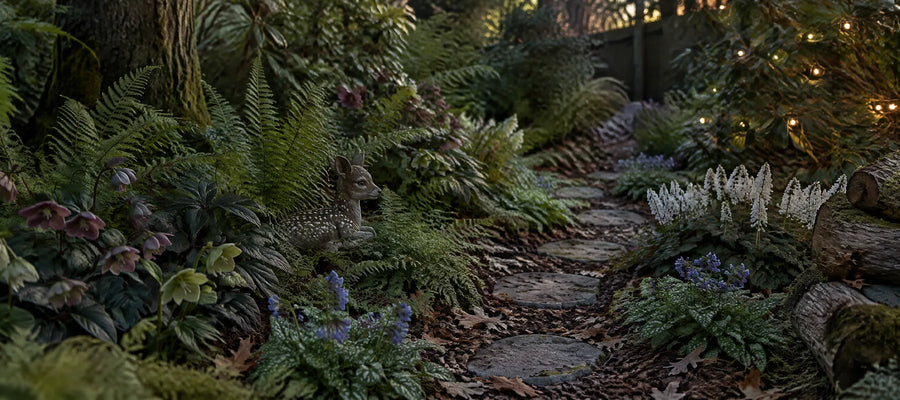
If you have a tree, a stump or a shaded wall, you do not need a container at all. Set a tiny arched door against the roots, edge a patch with stepping stones, and plant moss, small ferns and brass buttons around it. Shady, secluded spots around trees and shrubs suit fairy gardens well because the plants stay soft and mossy there.

The windowsill winter bowl
When the outdoor season ends, a fairy garden can move inside. Use a wide glass bowl, moss and a few small foliage plants, and leave the top open. A closed lid traps moisture and invites mold, and succulents in particular should not be sealed. A battery string light adds the winter glow.
Working with a patio or balcony, not just a bowl? The Small Garden Design Planner helps you measure, draw to scale and cost a layout before you buy anything.
See the planner →Accessories and scale
Props are what make people smile, and also what make a bowl look like a toy shelf. A few rules help. Pick one scale and stay with it: if the front door is two inches tall, the bench and the lantern should look like they belong to the same household. Choose natural materials (stone, twig, shell, weathered wood) where you can, and keep the number of pieces low enough that the plants stay the main event.
Anything that touches the soil in the rain should be weatherproof. Resin and glazed ceramic hold up outdoors; paper, untreated wood and cheap paint do not. Many accessories also have small parts, so keep them out of reach of toddlers and pets.

84-piece fairy garden accessories set
A good starting option when you want variety without buying each piece separately. The listing describes a mix of mini resin animals, mushrooms, a bridge and a pond, made for terrariums, succulent bowls and DIY garden scenes. Use a handful rather than the whole set, so the plants still lead.
Check before buying: the exact pieces included can change between listings, and the set is plastic and resin rather than natural material. Small parts.
View on Amazon →How to build one, step by step
- Pick the spot first. Decide whether the container will sit in sun or shade, then choose plants to match. Moving it later is possible, but plants sulk.
- Prepare the container. Confirm there is at least one drainage hole. Lay a small piece of mesh or a curved pot shard over the hole so mix cannot wash out.
- Fill with fresh mix. Use container potting mix, or a cactus or grit-amended mix for succulents. Leave about an inch below the rim so water can pool without spilling.
- Place the plants and props dry. Set the focal point and path first, then arrange plants in their nursery pots to see how the scene reads. Move things until it feels balanced.
- Plant the tallest first. Pop the dwarf conifer or focal plant out of its pot, loosen the roots, and set it at the same depth it was growing. Then add mid-height plants and finish with the ground cover.
- Add the path and props. Press pebbles into the surface. Set houses and benches level, and anchor anything light.
- Water in gently. Pour slowly at the base until water runs out of the drainage holes. Pouring from a cup erodes soil and shifts the plants.
- Settle it for a week. Keep it out of the hottest afternoon sun while the roots establish, then move it to its final spot.
Watering and care
The University of Maryland Extension calls improper watering, both too much and too little, the main cause of container failure, and Illinois Extension adds that how often you water depends on the season, container material, plant type and how long the container has been planted. In practice, use your finger: if the top inch of mix is dry, water; if it is still damp, wait. Water until it runs out of the bottom, then let the excess drain away.
If a container dries so far that the mix shrinks away from the sides, water runs down the gap and the roots stay dry. Water slowly a second time, or stand the pot halfway in a bucket of water until the surface darkens, as Maryland Extension suggests. Empty saucers after rain and watering so the roots never sit in a puddle.
Feed lightly. Arizona Extension suggests diluted fertilizer because water drains out of a container quickly and carries nutrients with it, and the University of Wisconsin warns that too much nitrogen makes moss grow lumpy rather than flat. Too much feed also stretches plants and wrecks the miniature look.

Stainless steel long-spout mini watering can
A narrow spout lets you water the soil at the base of a crowded bowl without flooding the moss or knocking over props. The listing describes a 13.5 oz stainless steel can with a long spout, made for small plants and succulents.
Check before buying: it holds a small volume, so a large bowl may need two or three fills. A squeeze bottle or a spray bottle with a fine stream works too.
View on Amazon →Weekly fairy garden checklist
- Check the top inch of mix and water only if it is dry
- Empty any saucer of standing water
- Trim plants that have outgrown the scale
- Pick off dead leaves and moss browning at the edges
- Rotate the container a quarter turn so growth stays even
- Reset props that have shifted or tipped
- Look under dwarf conifer branches for spider mites in dry weather
Trimming matters more here than in a normal garden, because a thyme that grows two inches taller than the cottage changes the whole picture. Pinch back thyme and sedum tips, shear moss lightly with scissors, and take out any plant that has plainly outgrown the bowl. A pair of narrow-tipped snips reaches into tight spaces without crushing the neighbors.

Fiskars Micro-Tip pruning snips
For fiddly trimming, micro-tip blades cut right to the point, so you can pinch back one thyme stem without touching the moss beside it. The listing describes 6-inch snips with micro-tip blades, a spring action and a lifetime warranty.
Check before buying: these are general plant snips, not made specifically for miniature gardens. Craft scissors with fine tips also work.
View on Amazon →Getting through winter
Container plants face two problems in winter: they can dry out, and they can freeze, and freezing can damage both the roots and the pot. Arizona Extension's overwintering guidance for containers is practical: water one last time before cold sets in, cut back perennials, and either wrap the container in insulation (burlap, bubble wrap, mulch or leaves) or move it into a sheltered spot like a garage or basement.
For fairy gardens, that breaks down by plant. Hens-and-chicks and dwarf conifers are hardy and can usually stay outside if the pot itself survives, though a pot full of wet mix in a freeze-thaw cycle is a risk, so raise it off the ground and keep it from sitting in rain. Baby's tears and other tender plants should come indoors. Annuals can simply be composted, and the props washed and stored.
Your first frost date decides the schedule. For a step-by-step approach to cold nights, our guide on how to protect your garden from the first frost covers covers, timing and what to move first.
Common mistakes
| Mistake | What happens | Fix |
|---|---|---|
| No drainage hole | Roots sit wet and rot | Drill holes, or use the pot as a cache pot around a plain one |
| Garden soil in a pot | Compacts and drains badly | Use fresh container mix (add grit for succulents) |
| Mixing wet and dry plants | One group always suffers | Group by light and water needs |
| Too many props | Scene looks cluttered; plants squeezed | Keep a third of the surface open |
| Fast growers in a tiny bowl | The scene outgrows its scale in one season | Choose slow, low plants; trim often |
| Watering on a schedule, not by feel | Overwatered one week, bone dry the next | Check the top inch of mix with a finger |
| Leaving cold-tender plants out | Frost kills baby's tears and cracks thin pots | Bring tender pots under cover before hard frost |
FAQ
What is the best container for a small fairy garden?
A wide, shallow container with drainage holes, such as a terracotta bowl or a bulb pan. The wide surface gives you room for a path and plants, and the shallow depth keeps the mix from staying wet.
Can I make a fairy garden without drainage holes?
You can, but it is much harder to keep plants alive. Add holes with a drill, or plant in a regular pot with holes and set it inside the decorative container. If you do use a no-drainage glass bowl indoors, water very lightly and use moss or other plants that tolerate steady moisture.
What plants should I use?
Slow-growing, small-leaved plants: Irish moss, creeping thyme, baby's tears, dwarf mondo grass, small sedums, hens-and-chicks and a dwarf conifer. Match them to the light you have.
How often should I water a fairy garden?
There is no fixed schedule. Check the top inch of mix and water when it is dry, until water drains from the bottom. Containers in sun and wind dry fastest.
Can a fairy garden stay outside in winter?
Hardy plants like hens-and-chicks and dwarf conifers often can, but the pot needs protection from freeze-thaw damage. Tender plants like baby's tears should come inside. Check your local frost dates.
Do I need real plants?
The working definition from extension educators includes at least one living plant. Real plants are what make the scene look alive, and they are cheaper than a pile of accessories.
The takeaway
Treat a fairy garden like any other container: drainage, fresh mix, plants that share conditions, and a watering habit based on touch rather than a calendar. Do that and the tiny house on top is the easy part. For more ways to use limited ground, see our small backyard garden layout ideas, our low-water gravel garden ideas, and the storybook mood of woodland wilderkind garden ideas.
Turn these ideas into a plan for your own small space
A bowl is a start. If you are fitting a patio, balcony or tiny yard, a scaled plan stops you buying plants and pots that will not fit. The Small Garden Design Planner puts it on paper first.
- Seven scale templates on a 1 square = 1 ft grid
- Cut-out shapes to try layouts before you buy
- Budget, shopping list and install order


59-page printable PDF, instant download. US Letter and A4. Lifestyle images are illustrative.
Products mentioned
| Product | Best for | Why it fits this article | Key feature to look for | Amazon |
|---|---|---|---|---|
| PSW 12-inch shallow bulb pan planter | A roomy base for a bowl-style scene | Wide, shallow container for paths and small plants | Drillable base: add drainage holes before planting | View |
| 84-piece fairy garden accessories set | Starter props on a budget | Houses, animals, bridge and pond in one set | Pick a few pieces that share a scale | View |
| Stainless steel long-spout mini watering can | Watering crowded miniature plantings | Narrow spout waters soil without disturbing props | Long, thin spout and a small capacity | View |
| Fiskars Micro-Tip pruning snips | Trimming thyme, sedum and moss | Micro-tip blades reach into tight spaces | Pointed blades that cut to the tip | View |
Gardensted has not tested any of these products. Product descriptions are based on manufacturer and retailer listings, which can change. Please confirm sizes, variants and availability on the product page.



0 comments