

Mowing is the one lawn job that asks for the same hour every week for six or seven months of the year. A robotic mower takes that job off your list completely. In exchange it hands you a different set of small jobs: mapping the lawn, finding a sensible spot for the dock, trimming the edges it can't reach, and swapping small blades more often than you'd ever sharpen a push mower's.
Whether that trade is worth well over a thousand dollars has less to do with the mower than with your lawn. Size, slope, tree cover and how much you care about striped, showpiece turf decide it. This guide covers those variables, the downsides that reviews tend to soften, and four mowers matched to different kinds of yard.
Robotic mowers are worth it for open to moderately complex lawns, especially if you currently pay for mowing or would happily hand back the hours. They're a weak buy for very small, simple lawns (a battery push mower is cheaper and quicker), for steep or cluttered ground, and for anyone who wants stripes. If you buy one, choose for the hardest part of your lawn, whether that's the slope, the shady corner or the narrow side gate, not the easy middle.
What you'll learn
- Which four lawn traits decide whether a robot mower is worth it
- What frequent light mowing does for grass, and what it can't do
- Realistic costs, with a break-even calculation you can adapt
- Why navigation type (wire, GPS or LiDAR) matters more than brand
- Four picks for different yards, plus a pre-purchase checklist
Is your lawn a good candidate? Four traits decide it
Independent testers keep landing on the same conclusion: robot mowers do best on lawns with clear boundaries and manageable slopes, and they struggle on very large, steep or obstacle-filled ground. Reviewed's 2026 roundup, which covered close to two dozen models, puts it in almost exactly those terms. In practice it comes down to four things.
| Trait | Good sign | Warning sign |
|---|---|---|
| Size and shape | One open area, or a few connected areas, within the mower's rated size | Many separate patches, or a lawn small and simple enough that a push mower takes 15 minutes |
| Slope | Gentle, or well within the mower's stated slope rating | Steep banks. Only all-wheel-drive models are built for them, and it's worth watching one work on a slope before you commit |
| Tree cover and sky view | Mostly open sky, or a mower with LiDAR or camera backup | Dense canopy over much of the lawn, which can disrupt satellite-based navigation |
| Clutter | Beds and edges with clear lines, few obstacles | Play equipment, ornaments, hoses and toys left on the grass, plus narrow gaps between beds |
Slope and tree cover are the two that catch people out. A lawn that looks flat from the patio can have a steep bank along one side, and a lawn that feels sunny can lose satellite signal beneath a mature oak. If you already know your lawn has one of those problems, weigh it heavily before anything else in this guide.
Usually worth it if…
- You pay for weekly mowing now
- You'd rather have the hours back than save the cash
- Your lawn is open, gently sloped and well defined
- You're away often and want the lawn kept tidy regardless
Usually not worth it if…
- The lawn is small, flat and simple
- You enjoy mowing, or want stripes
- The lawn has steep banks or heavy tree cover
- You'd rather not deal with app setup and troubleshooting
What robot mowing does to your lawn
A conventional mower removes a lot of grass once a week. A robot mower removes a very small amount, every day or every other day. That difference is the real reason robot-mown lawns often look better, and it lines up with standard turf advice: keep the cut to no more than about a third of the blade at a time, and mow often. An Oregon State University Extension turf specialist has said that frequent mowing during the growing season has more impact on turf quality than any other lawn practice except irrigation in summer.
There's newer evidence too. The University of Florida's IFAS Extension reported in 2026 that robotic mowers kept Florida lawns healthy, including St. Augustine grass, and that near-daily light cuts produced denser turf than the usual weekly schedule. The same guidance flags two local precautions, fire ants and lightning near docking stations. It's one regional study on warm-season grass, so treat it as encouraging rather than universal.

What you keep
Clippings are so fine they drop back into the turf as a light mulch. Extension research has long supported leaving clippings on the lawn, and Oregon State's work found that returning them can roughly halve the fertilizer a lawn needs. Robot mowing makes that easy, because there's nothing to bag.
What you give up
- Stripes. Robots are light machines without rollers, and many vary their path on purpose.
- Leaf clearing. A robot will chop leaves that lie at grass height. It won't clear a lawn the way a blower or a conventional mower with a bag will.
- Tall-grass recovery. Most guides advise cutting an overgrown lawn down with a conventional mower first, then letting the robot maintain it.

Set the cutting height for your grass type, not for the tidiest look. Higher cuts encourage deeper roots and help shade out weeds. If you're unsure how low is too low for your lawn, our guide to how often to mow by season and grass type covers heights and timing.
What it really costs
A retailer's 2026 buyer's guide puts a capable robotic mower for a quarter-acre lot at roughly $1,200 to $2,500, with larger yards pushing toward $3,500. The same guide prices a solid electric push mower under $400 and a good gas mower around $500. Those are one seller's figures, and street prices move around, but the gap is real: you're paying for automation, not for cutting power.
Running costs are small. Electricity is minor. Blades are the consumable that matters. Robot mower blades are thin and cheap, but they wear faster than a conventional blade, and Segway's own guidance says you may replace them several times a season.
A break-even calculation you can adapt
The useful comparison is the robot's price against what you spend now on mowing. The two scenarios below are hypothetical, and they exist to show the method. Swap in your own numbers.
| Scenario | What you spend now | Robot at an assumed $1,800 | Result |
|---|---|---|---|
|
You pay a mowing service $50 a visit, 26 visits a season |
$1,300 a season | Before blades and setup, about 1.4 seasons to break even | Cash savings arrive after year two |
|
You mow it yourself 45 minutes, 26 times a season |
Fuel and upkeep, plus about 19.5 hours of your time | Cash rarely wins against a $400–$500 mower | You're buying back the hours, so the question is what they're worth to you |
If your mowing is DIY and your lawn is simple, be honest about that second row. Nothing is wrong with paying for convenience, but it's a convenience purchase, not a savings one.
Pros and cons at a glance
Most of the honest downsides show up in the same places across independent tests and owner reports: edges, setup, slow progress and support when something goes wrong.
What works in their favor
- Hours back, every week of the growing season
- Consistent height and finer clippings, which can mean denser turf
- Electric and quiet; manufacturer figures for several wire-free models run around 58–62 dB
- Scheduling and zone control from a phone app
- Lawn stays tidy while you're away
- All-wheel-drive models handle slopes that used to rule robots out
What counts against them
- High upfront cost compared with any conventional mower
- Edges: centrally mounted blades leave a narrow strip along borders, so a string trimmer may still be needed unless the model has a dedicated edge trimmer
- Slow, steady progress; large lawns can take several sessions
- Won't clear leaves or tackle overgrown grass
- Setup and troubleshooting take patience, and repairs usually go through the manufacturer
- Wildlife risk if run at night (see below)
- Winter storage and blade changes to plan for
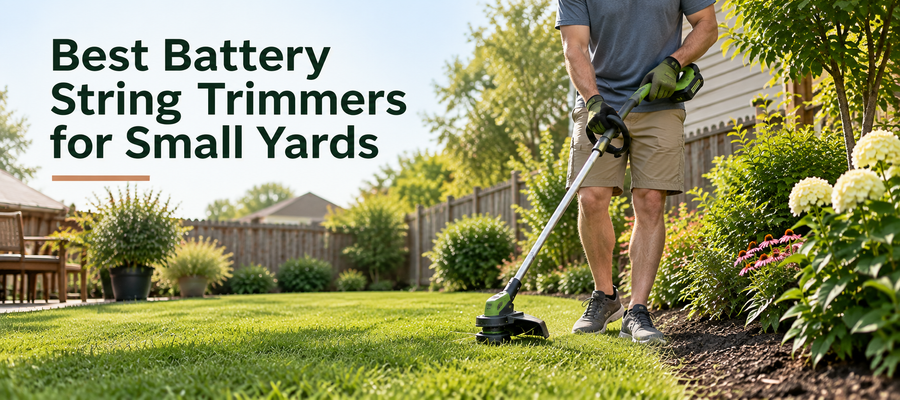
For the edge problem, a battery string trimmer is the usual companion. We cover good small-yard options in our guide to the best battery string trimmers for small yards.
Wire, GPS or LiDAR: pick the navigation that fits your trees
Navigation is the single biggest difference between models, and it's where most disappointing purchases start. There are four common approaches.
| System | How it finds its way | Works best on | Weak spot |
|---|---|---|---|
| Boundary wire | Follows a low-voltage wire laid or pegged around the lawn | Lawns where sky view is poor, or where you want a hard boundary | Installation effort, and wires can break |
| RTK satellite | Uses satellite positioning corrected by a base station or network | Large, open lawns | Trees and buildings can disrupt the signal |
| RTK plus camera | Satellite positioning with vision as backup | Mixed lawns with some tree cover | Still depends on decent sky view for most of the lawn |
| LiDAR | Builds a 3D map with laser scanning | Shady, obstacle-filled yards | Read the listing carefully, as models combine systems in different ways |

TechRadar's explainer on RTK makes the trade-off clear: satellite-based mowers are more prone to wandering off course than wire-guided ones, which is why most modern models add radar, LiDAR or a camera as a backup. In the UK, Gardeners' World's test lineup included a boundary-wire model, the Stihl iMOW 5, alongside wire-free ones, so wire is far from obsolete.
Brands quote slopes in percent or in degrees, and the two aren't interchangeable. A 45% slope is about 24 degrees, and an 80% slope is about 38.6 degrees, which are the pairings the listings below use. Check which unit a listing means before comparing two mowers.

Best picks for different yards
Gardensted hasn't tested any of these mowers. What follows draws on the manufacturers' Amazon listings, which are labeled as manufacturer claims, plus published independent testing from named outlets where it exists. I've matched each mower to a yard type rather than crowning one winner, because the right choice really does depend on the lawn.
These brands sell several near-identical versions of the same mower: with or without a garage, with or without cellular, and in low-cut or high-cut variants. On the LUBA mini 2, for example, the 1500 and 1500H differ in cutting-height range. Check the exact title before you order.
Best for small, awkward lawns: ECOVACS GOAT O1000 LiDAR PRO

ECOVACS GOAT O1000 LiDAR PRO
The listing describes wire-free dual-LiDAR mapping with no RTK antenna, a built-in edge trimmer, and the ability to pass through gaps as narrow as 0.8 m (31.5 in). It is rated for a 45% slope. Those are manufacturer claims, and the manufacturer itself notes that very tight corners or raised edges may still need occasional manual trimming. Ecovacs' larger GOAT models also lead Reviewed's independent 2026 testing, though the O1000 itself wasn't the model highlighted there.
View on Amazon →Best for open lawns with some slope: Segway Navimow i210 AWD

Segway Navimow i210 AWD Robot Lawn Mower
The listing describes a wire-free mower using network RTK plus vision for auto-mapping, all-wheel drive for 45% slopes, and coverage of about a quarter acre. The listing's garage ships separately. The Navimow range has a strong record in independent testing: Bob Vila's testers ranked the larger Navimow X430 best overall of seven wire-free models, and Reviewed names a Navimow as its best robot mower for the money. Neither test was of this exact model, so treat that as a reason to shortlist the brand, not as a verdict on the i210. Satellite navigation still wants reasonable sky view, so heavy shade is where to be cautious.
View on Amazon →Best for slopes and complicated layouts: Mammotion LUBA mini 2 AWD 1500H

Mammotion LUBA mini 2 AWD 1500H Robot Lawn Mower
Per the listing, this version combines 360° LiDAR with dual-camera AI vision, all-wheel drive rated for an 80% (38.6°) slope, up to 20 mowing zones, and dual cutting discs, a main disc plus an edge disc. The "H" version cuts between 2.2 and 4.0 inches, which suits cool-season lawns kept a bit taller; the non-H 1500 cuts lower. In the UK, Gardeners' World gave the LUBA mini 2 five stars as its best pick for bumpy or hilly ground. That was the UK model, so check the US listing's specifications.
View on Amazon →Best for larger lawns: ECOVACS GOAT A3000 LiDAR PRO

ECOVACS GOAT A3000 LiDAR PRO Robotic Lawn Mower
The listing describes dual-LiDAR navigation, coverage up to three-quarters of an acre, mowing efficiency of up to 400 m² an hour, and a built-in TruEdge edge trimmer. Reviewed, which tested close to two dozen robot mowers, names the Goat A3000 line as its favorite, and says the newer LiDAR PRO is the same mower with the added edge trimmer. It's the biggest and priciest of the four picks, so it earns its place only when your lawn is genuinely large.
View on Amazon →Before you buy: a pre-purchase checklist
Ten minutes with a tape measure and the yard itself will prevent most returns.
Check these before ordering
- Measure the mowable turf only, not the whole property
- Find your steepest slope and check it against the mower's rating, in the right unit
- Note how much of the lawn sits under trees or roofs
- Measure your narrowest gap against the mower's stated minimum passage
- Pick a level dock spot near an outdoor outlet and check your Wi-Fi or cellular reach there
- Decide how you'll handle the edges: a string trimmer, or a model with an edge trimmer
- Check whether anti-theft or cellular features are included or an extra
- Plan where the mower will spend the winter
- Read the exact listing title for the right version and cutting-height range

Mistakes that make a robot mower feel like a bad purchase
- Starting on a tall lawn. Cut it down first, then let the robot maintain it.
- Buying for the easy middle. The steepest bank or shadiest corner is what will frustrate you.
- Skipping the edge plan. Without one, the border strip looks unfinished by week two.
- Running it at night. See the wildlife section below.
- Setting the cut too low. Scalping stresses grass. Our roundup of lawn mowing mistakes explains why height matters.
- Ignoring blades. Dull blades tear grass, so check them regularly.
Wildlife and safety
This is the downside that gets the least attention in product reviews. Hedgehogs, which curl up rather than flee, are the best-documented casualty, and the British Hedgehog Preservation Society and a study by Oxford and Aalborg researchers both point to the same practical advice: run mowers in daylight only. That study found real differences between models in how much harm they caused to test hedgehogs, with features such as pivoting blades and skid plates helping, so it isn't only a scheduling question.
Schedule mowing between roughly mid-morning and late afternoon, and walk the lawn first if you know young wildlife is around. Leverets, amphibians and fledglings can all be hidden in longer grass. Restricting run time means the mower needs enough capacity to finish the job in daylight, so factor that in when you choose a size.
Consider leaving a no-mow refuge, such as a wilder edge or border corner, as a safe zone. Most models let you define no-go areas in the app.
Autumn and winter: the timing question
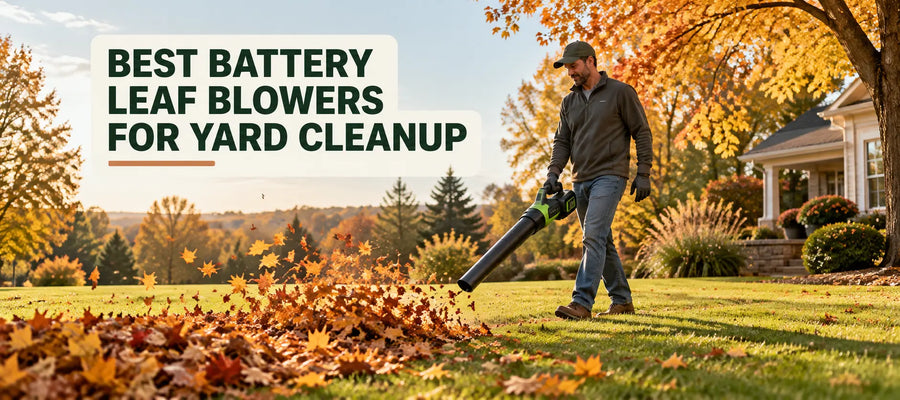
If you're reading this in October, two things are worth knowing. First, autumn leaves. A robot will cut leaves that lie at grass height, but it won't clear them, so you'll still want a blower or rake for heavy drop; our guide to the best battery leaf blowers for yard cleanup covers the tool side.
Second, winter. Manufacturers generally advise storing the mower, or at least its battery, indoors over winter, so check the manual for your model. A mower in storage isn't earning its keep, which is why some buyers wait until spring to buy. Buying now does give you time to map the lawn before the season starts.

A note for UK readers
UK gardens are smaller than most US lots, which makes the "is it worth it" question sharper: many lawns are small enough for a cheap push mower or cylinder mower. Gardeners' World's 2026 test lineup runs from the LawnMaster OcuMow 16 at a £299.99 RRP up through the Segway Navimow i208 LiDAR, the Mammotion LUBA mini 2 and the boundary-wire Stihl iMOW 5. Those RRPs are from their test and may have changed. Models and specifications on Amazon.co.uk often differ from the US versions above, so treat the picks in this article as a guide to the categories rather than exact UK buys.
If a robot isn't right for your lawn
A small, simple lawn is usually better served by a compact battery push mower or a reel mower, both covered in our best lawn mowers for small, medium and large yards guide. If the real goal is less mowing, not more automation, our low-maintenance lawn ideas show how to shrink the amount of grass you have to cut.

Quick questions
Do I still need a string trimmer?
Usually, yes. Most robot mowers leave a narrow strip at borders because the blade sits in the middle of the body. Models with edge trimmers or edge discs reduce this, but manufacturers themselves say very tight corners may need a manual touch-up.
Can it start on an overgrown lawn?
It's best not to. Robot mowers are designed to maintain a lawn that's already kept short, so cut the grass down with a conventional mower first.
Do I need to collect the clippings?
No. The clippings are fine enough to fall back into the turf and act as a light mulch.
Will someone steal it?
It's a real concern with valuable machines. Some models include lift alarms or GPS tracking, while others treat cellular tracking as an optional add-on, so check what your listing includes.
The key takeaway
A robotic mower is worth it when your lawn is open enough to suit its navigation, gentle enough for its slope rating, and large enough that mowing is a real chore. In that case it hands back dozens of hours a season and often improves the grass. If your lawn is small and simple, or steep and shady, a conventional mower or a smaller lawn will serve you better. Decide on the hardest part of your yard, then pick the navigation to match.
| Product | Best For | Why It Fits This Article | Key Feature to Look For | Amazon |
|---|---|---|---|---|
| ECOVACS GOAT O1000 LiDAR PRO | Small, narrow or shady lawns to about ¼ acre | Wire-free LiDAR handles tight passages and tree cover | 0.8 m minimum passage; built-in edge trimmer | View on Amazon |
| Segway Navimow i210 AWD | Open lawns with moderate slopes, to about ¼ acre | RTK plus vision, AWD for 45% slopes, well-tested brand range | All-wheel drive; sky view for RTK | View on Amazon |
| Mammotion LUBA mini 2 AWD 1500H | Slopes and complex layouts, to about 0.37 acre | LiDAR plus dual cameras, 80% slope rating, edge disc | 2.2–4.0 in cutting range on the H version | View on Amazon |
| ECOVACS GOAT A3000 LiDAR PRO | Larger lawns to about ¾ acre | Dual LiDAR with high coverage rate; Ecovacs' A3000 line is Reviewed's favorite | Built-in TruEdge edge trimmer; up to 400 m²/h | View on Amazon |
Sources
- Reviewed — Best Robot Lawn Mowers of 2026
- Bob Vila — The Best Robotic Lawn Mowers of 2026
- Gardeners' World — The best robot lawn mowers for 2026
- University of Florida IFAS — Robotic mowers and Florida lawn health
- Oregon State University Extension — Leave grass clippings on the lawn
- TechRadar — What is RTK for robot lawn mowers?
- British Hedgehog Preservation Society — Robotic lawn mowers and hedgehogs
- PubMed — Effect of robotic lawn mowers on European hedgehogs
- Lawnmowers.com — Robotic Lawn Mowers in 2026 (retailer cost figures)



0 comments