

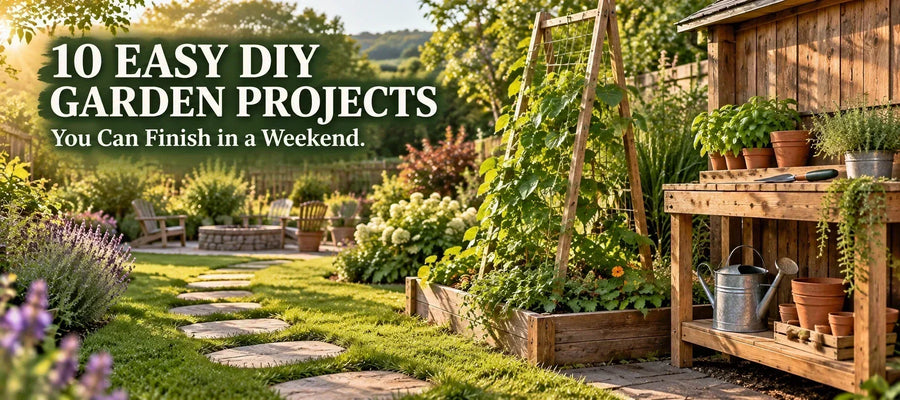
A bare fence, a blank brick wall, a bed that is already full: every one of them has height you are not using. Growing up is the cheapest extra square footage a gardener can get, and most of the materials are things you can pick up in one trip: some timber or bamboo, wire or netting, a handful of screws.
Autumn is a sensible time to build. Climbers and wall planters do best when the structure is standing before the plants go in (the RHS gives exactly that advice for wall plants), and a weekend project now is one fewer job in spring. This guide covers ten builds in two groups: six trellises for plants that climb, and four vertical wall designs for plants that do not. Each one says what it suits, how it goes together and where it tends to go wrong.
- How to match a support to the way each plant actually climbs, and how tall it needs to be
- Six DIY trellis builds, from a quick bamboo teepee to a permanent post-and-wire system
- Four vertical garden wall builds for herbs, salad greens and strawberries
- How to fix a trellis to a wall without trapping moisture, and how to protect a wall behind a planter
- Which wood is sensible for structures that hold edible plants, and the mistakes that bring trellises down
The short version
For beans, peas and cucumbers, build a tall trellis and anchor it well: pole beans want roughly 6 to 8 ft, and the structure has to survive summer storms. For ornamental climbers on a wall, fix a trellis on battens about 5 cm (2 in) off the surface, with its bottom edge about 30 cm (1 ft) above the soil. For herbs, salad and strawberries on a blank wall, stick to shallow-rooted plants in pockets 6 to 8 in deep and keep water off the wall behind them. Use untreated, rot-resistant wood such as cedar for anything that holds soil for edibles. Build first, plant second.
Match the support to the plant
Before you cut anything, find out how your plant climbs, because that decides what it can hold on to. The University of California Master Gardeners in Marin County point out that beans climb by twining around vertical strings and supports, while peas and cucumbers climb with tendrils that grab onto both vertical and horizontal members. Tendril climbers often need a nudge toward the trellis and a few ties to keep wayward shoots in place.
Weight is the second question. University of Minnesota Extension says lightweight netting gives adequate support for beans and peas, that cucumbers and small squash do not slip from the vine and so need no extra sling, and that larger squash and pumpkins are simply too heavy to trellis. Trellised vine crops also tend to produce straighter, cleaner fruit than ones sprawling on the ground.
| Plant | How it climbs | Support that suits it | Height to plan for |
|---|---|---|---|
| Pole beans | Twines around uprights and string | Tall teepee, string or net trellis, post-and-wire | 6 to 8 ft, strong enough for summer storms (University of Maryland Extension guidance, as summarised by Gardening Beyond) |
| Peas and sweet peas | Tendrils | Netting, branch trellis, wire or mesh | Varies by variety; sweet peas grown for cutting often get 5 to 7 ft |
| Cucumbers | Tendrils | A-frame, panel or net trellis | About 5 to 6 ft for vining types |
| Small squash and gourds | Tendrils, heavier vines | Rigid panel or arch, firmly anchored | Match to the vine; support the structure, not the fruit |
| Pumpkins, large squash | Sprawling | Grow on the ground | Too heavy to trellis (University of Minnesota Extension) |
| Clematis, climbing roses | Twining stems or tied-in canes | Wall trellis or wires on battens | Depends on the plant; fix supports before planting |
A trellis behaves like a sail once it is covered in foliage. A UK trellis-fixing guide notes that solid, small-square trellis catches more wind than open diamond trellis, and the Old Farmer's Almanac suggests anchoring a freestanding trellis in a windy garden with landscape stakes or by securing it to T-posts. University of Minnesota Extension adds that stake strength depends on how deeply the stakes are set. Dig the base in properly.
Materials, wood and fixings
Most trellis builds need only a short kit: a drill or driver, a saw, a level, exterior-grade screws (galvanised or stainless, so they do not stain the timber), twine or soft ties, and a staple gun for netting and fabric. In the US, the thin timber strips used as spacers are called furring strips; in the UK they are battens. Same idea, different word.
Wood deserves a minute of thought. Pressure-treated lumber made with arsenic (CCA) was restricted for residential use in the US in 2004, according to Oregon State University Extension, and newer ACQ treatments do not contain arsenic or chromium. Even so, the University of Saskatchewan's gardening guide does not recommend pressure-treated lumber for vegetable beds, and warns against railway ties treated with creosote altogether. University of Maine Extension suggests untreated, naturally rot-resistant woods such as cedar or hemlock for beds. A reasonable rule for this project: use cedar or other untreated rot-resistant wood for anything that holds soil for edible plants (the pallet, the frame-and-planter wall, ladder shelves), and finish posts and trellis frames that never touch edible soil however you prefer. Reclaimed wood is best kept for flowers, since you cannot tell by looking whether it was treated.
Before you start any build
- Pick a spot with the sun your plants need: six or more hours for most edibles
- Check the wall or fence will carry the weight of the frame, soil and wet plants
- Choose untreated, rot-resistant wood for anything that holds edible soil
- Decide where the structure will be anchored, and how deep the posts or stakes will go
- Put the support in before you plant, not after
Six DIY trellis builds
These range from a thirty-minute project to a permanent installation. If you are building a trellis at the back of a raised bed, the beds in our guide to elevated metal raised beds for small yards and patios can carry a net trellis along the north side so the climbers do not shade their neighbours.

Build 1: Bamboo cane teepee
The simplest vertical support there is. The Almanac describes bamboo and willow teepees as ideal for climbing peas and beans, and recommends taller, sturdier ones built from thicker poles for heavier climbers such as squash and melons.
- Build: push a ring of canes firmly into the soil, lean them together at the top and lash them with twine. Plant one bean beside each cane.
- Height: for pole beans, use canes long enough to give the 6 to 8 ft the plants want.
- Watch for: shallow canes. Depth in the soil is what keeps a loaded teepee upright in wind.
Disclosure: This article contains Amazon affiliate links. If you purchase through these links, Gardensted may earn a commission at no additional cost to you.
As an Amazon Associate I earn from qualifying purchases.
Gardensted has not tested any of the products below. Descriptions come from product listings and manufacturer information, so check the current Amazon listing for size, variant and availability.

Cambaverd Natural Bamboo Stakes (25-pack)
One suitable option for a teepee or a simple cane-and-string trellis. The listing describes natural bamboo stakes sold in a 25-pack and double-fumigated before shipping. For pole beans you will want the longest length offered.
- Listing details: 25 natural bamboo stakes; the version we found is 4 ft long, and other lengths appear to be sold under the same listing
- Check the length selector before ordering, since 4 ft stakes are too short for pole beans

Build 2: Two-sided A-frame with netting
The Almanac's DIY garden trellis is a sturdy two-sided frame for pole beans, peas, cucumbers and squash, and an A-frame suits a narrow bed because you can harvest from both sides. Gardening Beyond lists good stability among its strengths and a larger footprint as its cost.
- Build: make two rectangular frames from timber, join them at the top so they lean together, and staple or tie netting across both faces.
- Anchor: in a windy garden the Almanac suggests securing the legs with landscape stakes or T-posts.
- Watch for: loose netting. A flower-supply guide warns that slack mesh can entangle birds, so pull it taut.

VIVOSUN Heavy-Duty Polyester Plant Trellis Netting, 6-inch mesh
One suitable option for the netting on an A-frame or a post-and-wire trellis. The listing describes braided polyester netting with 6-inch square mesh in a 5 x 15 ft size, which you can cut to fit and reuse. The wide mesh lets you reach through to harvest.
- Listing details: 5 x 15 ft, 6-inch square mesh, braided polyester (other sizes may be offered)
- Keep it taut on sturdy uprights

Build 3: Natural branch trellis
Clemson Extension's school-garden team built one from pruned crape myrtle branches in under 30 minutes, using four upright branches set a foot apart for a trellis about 4 ft wide, then adding horizontal branches across them.
- Build: choose branches that are not too thick, since heavy ones make the trellis top-heavy and it may fall over. Clemson also suggests leaving the branches long until the structure is assembled, then trimming the ends.
- Use it for: lightweight crops. Natural material rots and loosens over time, so expect to replace or retie it each year.
- Watch for: a base that is not set into the soil firmly enough to hold against the wind.

Build 4: Wire panel arch
A rigid welded wire panel bent into an arch is one of the longest-lasting DIY trellises. The Almanac rates a cattle panel trellis as extremely durable for beans, cucumbers and squash, and Gardening Beyond calls the arch version striking but dependent on firm anchoring at both ends.
- Build: stand the panel on its edge between two beds, bend it into an arch and fix each end to a post or heavy stake driven well into the ground.
- Plan the clearance: make the arch tall enough to walk under comfortably. For more garden-structure ideas in this style, see our 20 pergola ideas.
- Watch for: unsupported ends. A panel with loose feet will rock in wind and pull out of the soil.

Build 5: Wall-mounted lattice on battens
The RHS advice is specific here. Fix supports about 5 cm (2 in) off the wall or fence, and if you use a wooden trellis, screw it to thick battens with the bottom of the trellis about 30 cm (1 ft) above soil level to prevent rotting. A UK wood-care guide suggests battens of roughly 30 to 60 mm and one in the middle of a large panel.
- Build: fix the battens to the wall first (use wall plugs in masonry), then pre-drill the trellis and screw it to the battens with corrosion-resistant screws.
- Planting: the RHS says to plant climbers about 30 to 45 cm (1 ft to 18 in) from the base of a wall, where the roots have room and can catch rain.
- Watch for: light trellis with heavy plants. The UK trellis-fixing guide warns that wisteria and other heavy woody climbers can overload a thin panel, and a flat-fixed trellis traps damp and crowds stems against the wall.

Build 6: Permanent post-and-wire trellis
The UC Marin Master Gardeners replaced temporary supports that climbers kept overwhelming with permanent trellises made of metal stakes and heavy wire, which give beans, peas and cucumbers designated growing spaces. Vertical strings tied to the horizontal wires give young beans something to twine around.
- Build: set a sturdy post or stake at each end, brace them, and run several horizontal wires between them. The University of Wisconsin–Madison Extension describes posts set about 2 ft into the ground with tops about 6 ft above the soil, as summarised by Gardening Beyond.
- Train: tie in tendril climbers as they grow, and weave young tips into the net or wires.
- Watch for: wire that sags under a full crop. Tension it after planting and again midseason.
Whatever you build, plants need tying in. Soft, adjustable ties are kinder to stems than wire or string pulled tight, and you can reuse them.

VELCRO Brand Adjustable Plant Ties, 75 ft roll
A well-known option for tying tomatoes, peas and young climbers to a trellis. The listing describes reusable, cut-to-length, weather-resistant garden tape made from recycled plastic. You wrap it around the stem and support, and it grips itself without a knot.
- Listing details: 75 ft roll, reusable and adjustable (other roll sizes exist)
- Leave a little slack so the stem can thicken
Best forBeans, peas and cucumbers in a vegetable bed: A-frame, teepee or post-and-wire.
Look forAnchoring that survives a storm, and a height that matches the plant.

Vegetable Garden Master System: Printable Planner
Trellis built, but not sure which crops go where, or when to sow them? This 149-page printable planner gives you a plan to follow instead of guesswork.
- 12 ready-made bed layouts for raised beds and small spaces
- One-page guides for 25 vegetables, including cucumbers, snap beans and peas, with spacing, depth and days to maturity
- Frost-date worksheet, planting calendars, succession and rotation schedules, harvest logs
Print-and-write PDF, instant download. Not a fillable form.
Four vertical garden wall builds
A vertical garden wall is a different job from a trellis. Nothing climbs; you are hanging soil on a wall, and soil is heavy when wet. Park Seed notes that plants with shallow roots such as herbs, vegetables and annual flowers grow best in vertical gardens, and Burpee puts the working depth at 6 to 8 in for shallow-rooted annuals in pocket planters, with chives needing roots only about 3 in long.
| Good in a wall pocket | Why | Keep out or give extra room |
|---|---|---|
| Thyme, parsley, chives, basil | Shallow roots and compact growth | Mint: Burpee advises giving it its own horizontal planter, because it spreads and smothers neighbours |
| Lettuce, arugula, spinach | Quick and shallow-rooted | Large tomatoes and heavy vines, which want far more soil and a strong structure |
| Strawberries, trailing nasturtiums | Trail over the edge of the pocket | Dwarf cherry tomatoes and peppers only work in deeper tower-style planters |
Three rules apply to every wall build below. First, light: place the wall where the plants get the sun they need, which for sun-loving herbs means a south-facing position in the northern hemisphere. Second, moisture: Insteading advises either waterproof sheeting between wall and garden or watertight planters, and suggests a freestanding design where you want to avoid marking fences or siding. Third, weight: This Old House says to make sure the wall can carry the frame and the plants. Put the wall near a tap, since a wall garden dries out faster than a bed. For a different take on the same idea, our guide to vertical and stackable planters for small-space vegetable gardens covers ready-made towers.

Build 7: Pallet living wall
The classic upcycling project. Royal Building Products' guide has you staple landscaping fabric across the back and around the edges of the pallet (one side and three edges), lay it fabric-side down, fill the gaps between slats with potting soil, plant, and keep it flat for one to two weeks before standing it up. Groundwork suggests about a week flat, then fixing it to a wall with screws and brackets that can take the weight.
- Choose the pallet carefully: look for one stamped HT, which means heat-treated. The University of Saskatchewan notes that treated and untreated wood look alike, so for edibles use a pallet you can identify, or keep pallet planting to flowers.
- Tools: a heavy-duty staple gun and weather-resistant staples make quick work of the fabric.
- Watch for: standing it up too soon. Roots need time to hold the soil in place.

Build 8: Frame-and-planter living wall
This Old House builds a frame-based living wall from rails fixed to the wall, with window box planters sitting on shelves, and picks perennials for the planting. The frame makes it easy to swap or lift individual boxes for watering or replanting.
- Build: cut rails to the width of the wall space, fix them securely to the wall, prop the frame in place, then hang the planters and shelves.
- Plant: trailing perennials, heuchera and ferns suit shady walls; sun-loving herbs suit a bright one.
- Watch for: the wall behind. Waterproof the surface or use watertight boxes so water does not run down the masonry.

Build 9: Fabric pocket wall planter
The no-carpentry option: a ready-made pocket planter hung from a fence or wall. Burpee notes that shallow-rooted annuals do fine in pockets 6 to 8 in deep, and that you should water in the morning and harvest early in the day.
- Hang it: fix it to hooks, screws or a sturdy fence with its grommets, and fill the pockets before it goes up if the weight is awkward.
- Plant: basil, parsley and lettuce in the upper pockets, strawberries and nasturtiums where they can trail.
- Watch for: pockets that are smaller than expected. Check the dimensions in the listing before you buy.

MEIWO 7-Pocket Hanging Vertical Garden Planter
One suitable option if you would rather not build. The listing describes a felt wall planter with seven pockets and larger, deeper pockets than the earlier version, for outdoor use. It suits herbs, strawberries and lettuce rather than anything deep-rooted.
- Listing details: 7 pockets, felt fabric, hanging design (the listing may offer a 2-pack)
- Some buyers found the pockets smaller than expected, so treat it as a shallow-root planter

Build 10: Ladder shelf garden
Park Seed lists an old ladder repurposed as a tiered shelving unit among its vertical garden ideas for small spaces, for dwarf vegetables such as cherry tomatoes, peppers, lettuce, radishes and bush beans. It leans, it needs no drilling, and it moves with you.
- Build: lay boards across the rungs, seal or paint them for outdoor use, and stand a pot on each step.
- Plant: herbs and salad in the upper tiers, larger pots at the bottom where the weight sits low and stable.
- Watch for: tipping. Lean it against a wall or fix the top, and keep heavy pots on the lowest shelf. For more small-space ideas see our small backyard garden layout ideas.
Common mistakes to avoid
Trellis mistakes
- Building too short. Pole beans want 6 to 8 ft; a 4 ft support turns them into a tangle at the top.
- Skipping the anchor. A loaded trellis acts as a sail. Set posts deep, add stakes or T-posts and brace freestanding frames.
- Screwing a trellis flat to the wall. Without a gap of about 5 cm (2 in) stems scrape, air cannot move and damp collects behind the panel.
- Leaving the bottom edge in the soil. The RHS recommends keeping a wooden trellis about 30 cm (1 ft) above soil level to prevent rot.
- Asking too much of the structure. Pumpkins and large squash are too heavy to trellis, and heavy woody climbers outgrow light panels.
Vertical wall mistakes
- Deep-rooted plants in shallow pockets. Stay with herbs, salad and strawberries.
- No protection behind the planter. Use sheeting or watertight boxes to keep the wall dry.
- Standing a pallet up too soon. Let it lie flat for a week or two so the roots can hold the soil.
Frequently asked questions
How tall should a garden trellis be?
It depends on the plant. For pole beans, plan for 6 to 8 ft; for cucumbers, around 5 to 6 ft is a practical height. Posts set into the ground lose some of their length, so measure the height above the soil, not the length of the stake.
Does a trellis need to be anchored?
Yes. Foliage catches wind, and stakes are only as strong as the depth they are set to. Anchor freestanding trellises with stakes, T-posts or concrete for larger structures, and fix wall trellises to battens with proper wall plugs.
Can I trellis squash and pumpkins?
Small squash and gourds, yes, on a rigid, well-anchored panel or arch. University of Minnesota Extension says larger squash and pumpkins are too heavy to trellis.
Which wood should I use?
Cedar or other untreated, rot-resistant wood is the safest choice for anything that holds soil for edibles. For trellis frames that stay out of edible soil, any exterior-grade timber that you treat or finish for the weather will do.
Will a vertical garden damage my wall?
It can if water sits against the surface. Insteading advises waterproof sheeting between the wall and the garden or watertight planters, and says a freestanding structure is better than fixing to fences or siding where marks matter.
Can I grow food in a pallet wall?
Use a pallet you can identify, ideally one stamped HT (heat-treated). Because treated and untreated wood look alike, the University of Saskatchewan suggests keeping recycled wood for flowers. Landscape fabric between the soil and the wood is a sensible extra layer.
The takeaway
Pick the build by plant, not by looks. Tall, firmly anchored trellises suit beans, peas and cucumbers; a batten-mounted lattice with a gap behind it suits wall climbers; and shallow pockets suit herbs, salad and strawberries on a vertical wall. Use untreated rot-resistant wood where edibles are involved, protect the wall behind any planter, and put the structure up before the plants. A weekend of work this autumn means a trellis ready for spring.
Products mentioned at a glance
| Product | Best for | Why it fits this article | Key feature to look for | Amazon |
|---|---|---|---|---|
| Cambaverd Natural Bamboo Stakes (25-pack) | Teepees and cane-and-string trellises | Cheap, quick support for beans and peas | Longest length offered (6 ft or more for pole beans) | View on Amazon |
| VIVOSUN Heavy-Duty Polyester Plant Trellis Netting, 6-inch mesh | A-frame and post-and-wire trellises | Gives tendril climbers something to grip | 6-inch mesh, cut-to-fit size | View on Amazon |
| VELCRO Brand Adjustable Plant Ties, 75 ft roll | Tying in climbers on any trellis | Soft, reusable ties that do not cut stems | Cut-to-length, reusable | View on Amazon |
| MEIWO 7-Pocket Hanging Vertical Garden Planter | A no-build vertical wall for herbs and salad | The ready-made version of the pocket-wall build | Pocket depth, outdoor-rated fabric | View on Amazon |

Gardensted Complete Garden Planner
Inspired by these builds but not sure how to fit them into your own space? The Complete Garden Planner (105 printable pages, US Letter and A4) walks you from measuring your space to a 90-day plan.
- Measuring guide, site worksheet and sun map, so you know where a trellis or wall planter will actually work
- Container planner, bed layouts and to-scale grids
- Budget planner and shopping lists for lumber, hardware and plants
Print-and-write PDF, instant download. Not a fillable form.
0 comments