

You do not need a big plot to keep eating from your garden after the first frost. A single raised bed and a few large pots can keep a household in kale, spinach, chard, lettuce and garlic through the cold months, as long as you plan around two things: shrinking daylight, and the fact that a pot freezes far faster than the ground does.
What you'll learn
- Whether a raised bed or containers suits your space better in winter
- Which crops earn their place in a small winter garden, and how far apart to space them
- A simple 4 x 4 ft winter bed plan you can copy or adapt
- The container rules that stop pots cracking and roots freezing
- When to protect, when to harvest, and the mistakes that cost the most plants
Quick answer
Choose cold-hardy leafy crops, garlic and carrots, plant them as early as your region allows, and space them a little wider than you would in summer. In containers, go bigger than you think, group the pots together against a sunny wall, mulch the surface, and do not feed them. Add a floating row cover on the coldest nights. Growth slows to a crawl in the darkest weeks, so treat the garden as a storage cupboard you harvest from lightly, not a production line.

In this guide
- Why winter growing is different in a small space
- Raised bed or containers?
- What to plant, and how much room it needs
- A 4 x 4 ft winter bed plan
- Container rules for winter
- Protecting plants on the coldest nights
- Harvesting without killing the plant
- Balconies and patios
- Common mistakes
- Winter checklist
- FAQ
- Useful gear
Why winter growing is different in a small space
Two things change once the weather turns, and both matter more when your garden is small.
Light, not just cold, sets the pace
NC State Extension points out that plant growth nearly stops when daylight falls below about 10 hours. In many temperate regions that happens around mid-November and lasts until roughly the first week of February, though the exact dates depend on your latitude. Nebraska Extension suggests adding 10 to 14 days to a crop's listed days to maturity to account for slower fall growth, and planning crops to be close to full size before the short days arrive. In practice: whatever you want to eat in January should be nearly grown by November.
Pots lose heat from every side
Penn State Extension notes that roots in a container can end up as cold as the air around them, while roots in the ground are insulated by soil. NC State also notes that pots freeze faster than the ground. Penn State's rule of thumb for overwintering plants in containers is to choose plants hardy to two zones colder than yours, and to use larger pots. Both ideas apply to winter vegetables too.
Hardy crops generally tolerate roughly 25 to 28°F, and semi-hardy crops 29 to 32°F, according to University of Maryland Extension. Your local extension service or national weather service can tell you your average first and last frost dates.
Raised bed or containers?
If you have the room for even one bed, it is the more forgiving option. If you have a patio, steps or a balcony, containers work, but they need more care. Many small-space gardeners end up using both.
| Factor | Raised bed | Containers |
|---|---|---|
| Freezing risk | Soil mass buffers the roots | Roots can get as cold as the air |
| Moisture | Holds steadier moisture | Dries or waterlogs faster |
| Best for | Garlic, carrots, bigger plantings | Greens, herbs, small harvests near the door |
| Flexibility | Fixed position | Can be moved to the sunniest, most sheltered spot |
| Effort in winter | Low | Moderate: grouping, mulching, watering checks |
Wherever you grow, our guide to elevated metal raised bed ideas for small yards and patios shows options for a patio or a tight yard, and 25 small vegetable garden ideas covers layouts for the rest of the year.
What to plant, and how much room it needs
Pick crops that tolerate frost and that you will actually eat. For the full list of the toughest crops, see our guide to cold-hardy vegetables to grow in winter. The RHS lists hardy winter crops such as kale, chard, spinach, winter lettuce, leeks and garlic.
The spacing below comes from university extension guidance for container growing. For winter, space plants a little wider than the minimum and avoid heavy feeding, as Territorial Seed advises, because soft, fast growth is more easily damaged by cold.
| Crop | Spacing | Container depth | Notes |
|---|---|---|---|
| Lettuce (loose-leaf) | About 6 in apart | 9 to 12 in of soil | Cut outer leaves; protect on hard-freeze nights |
| Spinach | About 5 in apart | Shallow to medium pots work | One of the most reliable winter greens |
| Kale | Wider spacing; large plants | Deep, large pot | Best in the back of a bed, or one per big pot |
| Chard | About 6 in apart | Medium to deep | Often tolerates cold well, then slows in the darkest weeks |
| Carrots | About 2 in apart | 9 to 18 in, depending on variety | Mulch deeply over the tops before a hard freeze |
| Cabbage | About 12 in apart | 12 to 14 in | Needs a large container; one or two at most |
| Beets | About 3 in apart | Medium | Thin seedlings; the greens are edible too |
| Garlic | About 6 in apart | 8 in or deeper | Plant cloves in autumn, harvest the following summer |
Spacings and depths are drawn from UC Cooperative Extension container guidance and University of Illinois Extension. Container size matters more than most people expect: Illinois Extension lists minimum pot diameters and soil volumes by crop, and the RHS suggests a pot of about 45 cm (18 in) for larger vegetables.
If you are planting now
If it is already October or later where you are, be realistic. Garlic cloves and young transplants of kale, chard and lettuce are the best bets. Seeds sown very late may germinate but grow too slowly to harvest before the short days, so they may only sit as small plants until spring. That is not a failure: a bed of small, healthy plants often gives an early spring harvest. How it plays out depends on your region, so check your local frost dates.
A 4 x 4 ft winter bed plan
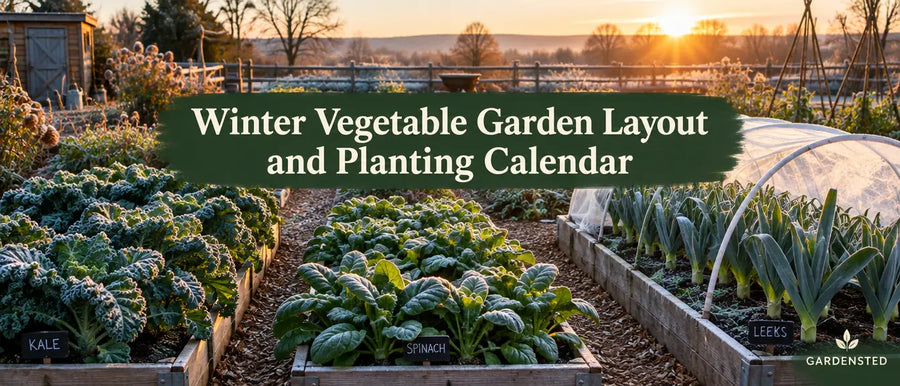
Here is a simple layout for a 4 x 4 ft raised bed. It is an editorial suggestion, not a tested plan, so adjust it for your climate and what you like to eat. The idea is to put tall, sturdy plants at the back, root crops in the middle, and the quick-cutting greens at the front where they are easy to reach and cover.

| Band (back to front) | Crop | Spacing | Roughly how many |
|---|---|---|---|
| 1. Back | Kale and chard | About 16 in apart | 3 plants |
| 2. | Garlic | About 6 in apart in the row | 6 to 8 cloves |
| 3. | Carrots | About 2 in apart | One short row |
| 4. Front | Spinach and loose-leaf lettuce | About 5 to 6 in apart | 8 to 10 plants |
Finish with a layer of straw between plants. NC State recommends 4 or more inches of mulch over root crops before a hard freeze, and the same layer helps hold soil moisture around everything else. For more ideas on keeping a bed going without a greenhouse, see winter vegetable garden without a greenhouse.
Want a winter plan for your own bed? The Vegetable Garden Master System has a frost-date worksheet, 12 ready-made bed layouts and one-page guides for 25 crops, in a 149-page printable planner.
See the planner →Container rules for winter

- Go big. Bigger pots hold more soil, so they cool and freeze more slowly. Penn State recommends larger containers for overwintering.
- Group them. The RHS advises standing pots together against a wall, where they protect each other and gain some shelter.
- Watch the material. The RHS warns that clay and ceramic pots can crack in hard frost. Frost-hardy planters, plastic, or wood are safer in cold climates.
- Lift them off the ground. Pot feet let water drain freely and stop the base from sitting in a frozen puddle. The RHS also advises removing saucers in winter.
- Mulch the surface. A thick layer of straw slows heat loss from the soil.
- Do not feed. The RHS recommends no winter feeding; plants are barely growing.
- Water sparingly. Check the soil, and water on a mild morning only if it feels dry a couple of inches down. Waterlogged soil is a bigger risk than dry soil in many winters.

Protecting plants on the coldest nights
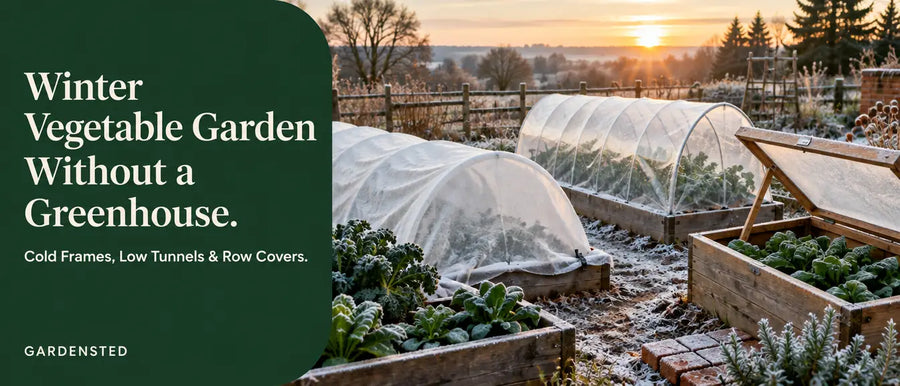
Hardy crops cope with cold on their own, but a layer of fabric can take the edge off severe nights and wind. A floating row cover laid directly over plants, or held up on low hoops, traps a little warmth and cuts wind damage. Keep the edges weighted down, and lift the cover on mild days so plants do not overheat. We cover this in detail in our guide to winter growing without a greenhouse.

If pigeons are a problem, the RHS recommends netting brassicas such as kale and cabbage.
Harvesting without killing the plant
In winter, plants take much longer to replace what you cut. Harvest the outer leaves of kale, chard, spinach and lettuce a few at a time and leave the growing centre intact. Take a little from each plant rather than stripping one. Harvest in the middle of the day when frost has melted from the leaves, because handling frozen leaves can damage them. Small snips make clean cuts without tugging the root.

Balconies and patios
A balcony can be a decent spot for winter greens if it is sheltered and gets some winter sun. Put the biggest pots against the wall of the building, where they catch the most reflected warmth and the least wind. A railing planter suits shallow-rooted greens like lettuce and spinach, but it exposes the soil to the cold on more sides, so mulch and cover it on harsh nights. Chives and parsley fit well in the leftover pot space.

Common mistakes
- Starting too late. Growth nearly stops when daylight drops below about 10 hours, so late sowings often stall.
- Using small pots. Small volumes of soil freeze through quickly.
- Leaving saucers on. Trapped water freezes and can crack pots or drown roots.
- Feeding in winter. It pushes soft growth that the cold punishes.
- Overwatering. Cold, wet roots rot. Water only when the soil is dry below the surface.
- Harvesting too hard. Stripping a plant in January may finish it off.
- Planting too close. Crowded plants hold moisture and invite disease when air barely moves.
- Using fragile pots outdoors. Untreated clay and ceramic can crack in hard frost.
Winter checklist
- Check your local first and last frost dates
- Choose hardy crops and plant early enough to be near mature by mid-November
- Use large containers and group them against a sunny wall
- Remove saucers and add pot feet
- Mulch with straw, 4 inches or more on root crops
- Stop fertilising
- Keep a row cover and hoops ready for hard-freeze nights
- Harvest lightly, a few outer leaves at a time
FAQ
Can you really grow vegetables in containers in winter?
Yes, if you pick hardy crops, use large pots, and protect them from the coldest nights. Container roots get colder than roots in the ground, so Penn State recommends going two zones colder than your own when choosing plants.
What is the easiest winter crop for a beginner?
Spinach and kale are usually good starting points, and garlic is easy because you plant it in autumn and then mostly leave it alone.
Do I need a greenhouse?
No. A bed with straw mulch and a floating row cover will carry hardy crops through many winters. See our guide to winter growing without a greenhouse.
Should I fertilise in winter?
Generally no. The RHS advises against winter feeding, and Territorial Seed suggests not fertilising winter crops heavily.
Will my pots crack?
Clay and ceramic can crack in hard frost, according to the RHS. Plastic, wood or frost-hardy planters are safer, and removing saucers helps.
Useful gear

Agfabric Floating Row Cover
Best for: Draping over a bed or hoops to blunt wind and frost.
Why it earns a place: Lightweight fabric is easy to lift for harvesting and sits on top of the plants.
Watch out for: Weights and sizes vary between listings, so check the weight and dimensions before buying.

Gardzen Garden Hoops
Best for: Holding row cover clear of the leaves over a raised bed.
Why it earns a place: Hoops create a mini tunnel so fabric does not press on the plants.
Watch out for: Check that the hoop width and length fit your bed before you order.

Potrisers Pot Feet
Best for: Lifting large containers so water drains and bases do not freeze to the ground.
Why it earns a place: Better drainage is one of the simplest ways to reduce winter pot problems.
Watch out for: Pack sizes differ; make sure you get enough feet for the number of pots you have.

Fiskars Micro-Tip Garden Snips
Best for: Harvesting outer leaves cleanly without pulling up roots.
Why it earns a place: Small, precise tips are handy among crowded winter greens.
Watch out for: Not meant for woody stems; use proper pruners for those.
| Product | What it does | Best for |
|---|---|---|
| Agfabric Floating Row Cover | Insulating, breathable fabric | Frost and wind on beds |
| Gardzen Garden Hoops | Supports fabric above plants | Raised-bed tunnels |
| Potrisers Pot Feet | Raises pots off the ground | Drainage on patios |
| Fiskars Micro-Tip Snips | Precision cutting | Harvesting greens |
The takeaway
A small winter garden works best when you plan it like a pantry: plant early, choose hardy crops, give roots enough soil to buffer the cold, and harvest a little at a time. Start with one bed or a cluster of big pots against a sunny wall. Add a row cover for the harshest nights, and you will have fresh greens when most gardens are bare.
Want to dig deeper? Read our guide to cold-hardy vegetables to grow in winter next.
Turn these ideas into a plan for your own beds
A small garden still needs a plan: which crops, where, and when. The Vegetable Garden Master System puts your frost dates, bed layouts and season calendar on paper.
- 12 ready-made bed layouts to copy or adapt
- A frost-date worksheet and planting calendars
- One-page guides for 25 crops: spacing, depth, days to maturity


149-page printable PDF, instant download. Crop guides cover 25 vegetables; kale, garlic and herbs are not in this edition.
Gardening advice here draws on guidance from Penn State Extension, NC State Extension, Nebraska Extension, University of Maryland Extension, University of Illinois Extension, UC Cooperative Extension, Washington State University Extension, the RHS and Territorial Seed. Growing dates and results vary by region, so check your local extension service.
0 comments