

Winter does not shut a vegetable garden down so much as sort it. A handful of crops shrug off frost, a few more need a blanket on the coldest nights, and the rest are finished at the first hard freeze. For a first winter, the smart move is not to grow everything. It is to pick the crops that forgive mistakes.
This guide ranks eight of those forgiving crops by how much they ask of you, says plainly which ones you can still start this month, and gives you a simple cover-or-don't rule so you stop second-guessing every cold forecast. If you want the wider reference list, with 12 crops and the hardiness numbers behind them, our guide to cold-hardy vegetables to grow in winter covers it. This one is the beginner shortlist.
One honest note on timing. Most of these crops need weeks or months to size up, and growth slows to a crawl as days shorten, a point we explain in our guide to what to plant in October and November. So for every crop below we say whether you can start it now, buy it as a plant, or should pencil it in for next summer.
What You'll Learn
- Which eight vegetables are the most forgiving in a first winter garden, grouped by how much effort they need
- What a light frost and a hard freeze actually mean for plants
- Which crops you can still start in October, and which to plan for next summer
- A simple rule for when to cover plants on a frosty night
- The beginner mistakes that cost first-winter gardens the most
The Short Version
Start with kale and garlic. University of Minnesota Extension rates kale as hardy to about 20°F (-6°C), and garlic is planted now and left alone until summer. Add spinach, radishes and arugula if you want fast leaves and have a cover to hand. Leave carrots and leeks as plans for next year unless they are already in the ground.
Hardy crops need no cover on an ordinary frosty night. Keep fabric and a few hoops ready for the borderline crops, and for nights forecast well below freezing.
What Frost Actually Does
Gardeners say "frost hardy" as though it were a single setting. It is closer to a ladder. Frost itself is simple: Michigan State University Extension defines it as air temperature at or below 32°F at ground level. What matters is how low and how long. Oregon State University's vegetable breeder James Myers, quoted by Gardener's Path, calls a vegetable "hardy" when it can take air temperatures below 28°F, and "half-hardy" when it tolerates the 28 to 32°F range.

| Tier | What it can take | Examples (Purdue Extension) | In this guide |
|---|---|---|---|
| Hardy | Hard frost | Kale, collards, spinach, radish, onion, peas, cabbage | Kale, collards, spinach, radishes |
| Semi-hardy | Light frost | Carrot, lettuce, chard, beets, parsnip | Carrots |
| Tender | Nothing: damaged by light frost | Tomato, pepper, bean, squash, cucumber | None, which is the point |
Purdue's list does not name leeks, garlic or arugula. The RHS describes leeks as hardy, and Smithsonian Gardens' fall planting guide lists arugula as very hardy.
How to read a frosted plant
Do not judge a plant at sunrise. Purdue Extension notes that in a light frost, often only the upper and outer foliage is damaged and the plants carry on producing. South Dakota State University Extension adds that warm weather after a short cold exposure can reverse some of the injury. Real freeze damage is different. Michigan State describes freeze-killed leaves as turning brown and translucent, or water-soaked, as they thaw, then curling and going brittle once dry, and says that damage cannot be undone.
A fair rule for a first winter: let frosted plants thaw, wait a few days, and only then cut away what is clearly dead. The RHS says leeks look a bit sick after sharp frosts but rebound, which is a good reminder that sad on Tuesday is not the same as dead on Friday.
Cold also changes flavor. Botanical Interests notes that sweetening is one way cool-season vegetables protect themselves from freezing, and South Dakota State says root crops develop more sugars when soil temperature is below 40°F. That is why a carrot or a leaf of kale can taste better after a few frosty nights.
One more detail that helps beginners buy the right plants: Botanical Interests, a seed company, says kale and spinach with savoyed, wavy, curled or textured leaves are generally hardier than smooth-leaved types. When you have a choice, take the crinkly one.
Because the forecast and your bed are rarely the same temperature, a thermometer sitting next to the crops settles the argument. Low spots collect cold air, and a mulched bed behaves differently from bare soil.

AcuRite Wireless Indoor/Outdoor Thermometer (model 00782A2)
A wireless sensor outdoors and a display indoors, so you can check the overnight low from the kitchen before deciding whether to cover the bed. The listing describes recent high and low records, which is the number that matters for frost decisions. Mount the sensor in shade near the crops, not against a sun-warmed wall.
View on Amazon →Eight Easy Crops, Ranked by Effort
We sorted the eight by the kind of effort they ask for, not by how fancy they are. Set-and-forget crops take the cold and ask for little. Quick wins grow fast but want a cover on bad nights. The patient root is a plan for next year. The last column is the one most beginner lists skip: whether you can actually start it this month.
| Crop | Type | Cold tolerance | Time to harvest | Start it this month? |
|---|---|---|---|---|
| Kale | Set-and-forget | Hardy; about 20°F (UMN) | 40 to 65 days (UMN) | As a bought plant, yes. Seed mostly sits in cold climates |
| Collards | Set-and-forget | Hardy; about 20°F (UMN) | 40 to 65 days (UMN); about 80 (Purdue) | As a bought plant, yes |
| Garlic | Set-and-forget | Plant in fall, mulch 4 to 6 in (Iowa State) | Harvest next summer | Yes, this is its month |
| Leeks | Set-and-forget | Hardy; no frost protection needed (RHS) | About 2 months for baby, up to 6 for full size (RHS) | No, plan for spring, unless already growing |
| Spinach | Quick win | Hardy (Purdue); may overwinter (UMN) | 35 to 45 days (UMN) | Early October in mild areas, ideally under cover |
| Radishes | Quick win | Hardy (Purdue); light frosts fine (Nebraska) | 24 to 30 days (UMass) | Mild areas, or under cover |
| Arugula | Quick win | Very hardy (Smithsonian); cloches advised for winter (RHS) | About 30 to 40 days (seed supplier) | Mild areas, under cover |
| Carrots | Patient root | Semi-hardy (Purdue); roots keep under mulch (Illinois Extension) | About 60 days (Purdue) | No, sow next August; mulch any already growing |
UMN is University of Minnesota Extension. Times are from extension planting guides for fall crops and vary by variety and region.
Group 1: Set-and-forgetThese four tolerate the cold with almost no help. Three are about patience, not skill.

1Kale
Kale is the benchmark. University of Minnesota Extension says it takes as long to mature as other brassicas but keeps growing in cool weather and survives cold down to about 20°F. The RHS rates it fully hardy and easy to moderate, and says it produces greens all winter, then a flush of tender shoots in late winter or spring.
Pick the outer leaves and leave the growing center so the plant keeps producing. Purdue notes that not every garden center stocks fall transplants, so if you find healthy kale plants this month, buy them. Seed sown now in a colder climate will mostly sit still until the days lengthen.

2Collards
Collards share kale's cold tolerance. University of Minnesota Extension lists them with kale, cabbage and Brussels sprouts as the hardiest of the fall vegetables, down to about 20°F, and Purdue puts them in its hardy tier. The large, smooth leaves are easy to harvest a few at a time from the bottom of the plant. Treat them exactly like kale: buy plants now, net them, and pick lightly.

3Garlic
Garlic runs on the opposite schedule from most vegetables: planted in fall, harvested the next summer. Iowa State University Extension recommends planting cloves pointed side up, 1 to 1.5 inches deep and 3 to 5 inches apart in well-drained, fertile soil. University of Illinois Extension gives 1 to 2 inches deep and 4 to 5 inches apart. Colder climates call for a little more depth, so check your local extension office.
Two rules matter more than the exact depth. First, buy seed garlic from a garden center or supplier. Iowa State warns against grocery-store garlic, which is usually a softneck type from warmer regions and may not suit your climate. Second, mulch. Iowa State suggests 4 to 6 inches of weed-seed-free straw in November, pulled back between the rows in early spring so the shoots can emerge. The RHS cautions that autumn planting does not suit heavy soils prone to waterlogging.

4Leeks
Leeks are about as low maintenance as winter vegetables get. The RHS says hardy winter varieties can stand in the coldest weather without protection, that late varieties can stay in the ground through winter into spring, and that frost may even sweeten the flavor. For UK winter use it recommends hardy cultivars such as 'Toledo' and 'Oarsman'.
The catch is the calendar. Leeks are slow, and the RHS describes sowing indoors from late winter and planting out in mid to late spring. If you do not already have leeks growing, treat them as a plan for next year. If you do, mulch the row where the ground freezes hard so you can still lift them in January.
These grow fast and taste best picked small. They are also the softest of the eight, so keep a cover handy.

5Spinach
Spinach is the fastest of the leafy crops here. University of Minnesota Extension says it survives light frost and may overwinter, and Purdue puts it in the hardy tier. Our read for beginners: established plants cope well, but soft, fast-grown young leaves can look rough after a hard night, so a light fabric cover is cheap insurance. Sow in early October only in milder areas, and ideally under cover. Further north, our guide to winter growing without a greenhouse shows what that cover can look like.

6Radishes
Radishes are the fastest vegetable on this list, and a good confidence builder. UMass Extension says they reach marketable size in 24 to 30 days and give their best roots when temperatures run between 50 and 65°F. Nebraska Extension notes that quick-maturing types suit fall gardens, because they are less likely to bolt in cooler, shorter days and can take light frosts.
The limit is light, not frost. Purdue's last feasible fall sowing for radishes in Indiana is mid to late September, so in colder regions this month's sowing belongs in a cold frame or under a hooped cover. In mild regions it can still go straight into the bed.

7Arugula (Rocket)
The RHS calls rocket robust and easy to grow even in poor soil, and says wild rocket crops over a long period, even in winter if protected under cloches. It suggests sowing outdoors until early September and for a further month under cloches or fleece, with short rows every few weeks for a steady supply. That UK window is a useful reminder that fall sowings work best when something covers them. Compact enough for a pot, arugula is also a natural fit for the containers in our small-space winter vegetable guide.

All three leafy crops are picked leaf by leaf. University of Minnesota Extension notes that leafy vegetables such as chard, kale and mustard greens can be harvested before the leaves reach full size, which keeps plants producing. Wait until frozen leaves have thawed before you pick, as they bruise easily. A sharp pair of snips makes cleaner cuts than fingers.

Fiskars Garden Snips
One suitable option for cutting kale, spinach and arugula leaves cleanly without yanking the plant. A sharp pair makes precise cuts near the stem and keeps you from tearing the crown. Keep them by the door; in winter you will be picking a few leaves at a time, not clearing whole beds.
View on Amazon →
8Carrots
Carrots sit in the semi-hardy tier, but that describes the foliage. The roots are better protected underground. University of Illinois Extension advises mulching the row with clean straw or loose leaves 6 to 8 inches deep, which keeps the soil from freezing solid so you can harvest into December, January and maybe February. Carrots can take temperatures down to freezing, it adds, and get sweeter.
The honest beginner reading: leave any carrots you already have growing, mulch them, and dig as needed. Purdue's last feasible fall sowing for carrots in Indiana is early to mid August, so a carrot sown this month will not reach size. Make a note to sow next summer. Keep the mulch dry, because soggy mulch can leave you with moldy roots.
Planning your first winter beds? The Vegetable Garden Master System has a frost-date worksheet, 12 ready-made bed layouts and one-page guides for 25 crops, in a 149-page printable planner.
See the planner →Cover or Don't: A Simple Rule
This is where beginners overdo it. North Carolina State Extension offers a clean rule of thumb: cover semi-hardy crops when temperatures are forecast below 30°F, and cover hardy crops when they are forecast below 25°F. It recommends frost cloth or a sheet and says not to use a plastic tarp. The National Weather Service issues a hard freeze warning when widespread temperatures below 28°F are expected during the growing season.
| Forecast low | Hardy crops (kale, collards, garlic, leeks) | Soft or semi-hardy (spinach, arugula, radish, carrot tops) |
|---|---|---|
| 30°F or above | Nothing to do | Nothing to do |
| 25 to 30°F | Nothing to do | Cover with fabric |
| Below 25°F | Cover, or add a second layer | Cover, with a second layer for a hard freeze |
Thresholds are adapted from NC State Extension. Treating young spinach, arugula and radish as soft is our own judgment, because their leaves are tender.

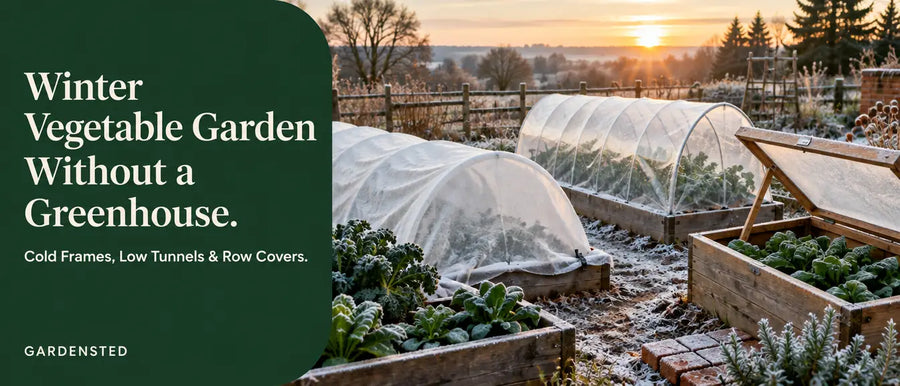
The simplest cover is a spun fabric draped over hoops. Purdue Extension suggests blankets or floating row covers supported by stakes or wire, so the cover does not press on the plants. Manufacturer ratings for row cover run from roughly 4°F of extra protection for light fabric to 8°F or more for heavy fabric, and heavier fabric lets in less light. Those are claims, not independent tests. For the full comparison of row covers, low tunnels and cold frames, see our guide to growing a winter vegetable garden without a greenhouse.

Agfabric Plant Covers Freeze Protection, 6 ft x 25 ft, 0.9 oz Frost Blanket
A roll of medium-weight frost cloth you can cut to length for a bed or short row. The listing states protection to 28°F, which is the manufacturer's claim. Check the width against your setup: a 6-foot roll suits a narrow bed under low hoops better than a wide bed under tall ones.
View on Amazon →Fabric that rests on leaves can still pass the cold through, which is why hoops help. A light-duty kit is enough for low, short tunnels over a raised bed.

Gardzen Garden Hoops for Raised Beds, DIY Kit for Row Cover, 24 Pcs
A fiberglass hoop kit that holds row cover or netting up and away from plants. It suits low, short tunnels over a raised bed, and the same hoops can carry insect netting in other seasons. Kits like this are light duty, so where heavy snow is likely you will want sturdier hoops. Check the listing for hoop height and sections per hoop before you order.
View on Amazon →If your garden has frost problems on shoulder-season nights, our guide to protecting your garden from the first frost covers what to do before the first hard freeze arrives.
Three Starter Beds
You do not need a layout diagram for a first winter, just a decision about how much effort you want to give. Here are three combinations, from least to most hands-on.
The No-Fuss Bed
Kale, collards and garlic. Bought plants for the brassicas, cloves around the edge, straw mulch on the garlic.
Effort: netting against pigeons, and not much else.
The Quick Salad Bed
Spinach, radishes and arugula. Short rows sown every couple of weeks under hooped fabric where winters allow.
Effort: a thermometer, a cover and light picking.
The Patient Bed
Carrots and leeks, if they are already growing. Mulch deeply and dig as you go.
Effort: mulch now, then a note to sow earlier next year.
What to Do This Week
First-Winter Checklist
- Look up your first and last frost dates with your local extension office
- Buy seed garlic (not grocery-store garlic) and plant it, then mulch in November
- Plant healthy kale or collard transplants if your garden center has them, and net them
- Sow spinach, radishes or arugula only if your winters are mild or you can cover them
- Mulch any carrots and leeks already in the ground
- Put a thermometer by the bed and keep fabric and hoops to hand
- Note next year's sowing dates now, using the timing rules in our October and November planting guide
Beginner Mistakes
- Sowing big crops too late. Kale, carrots and leeks need months. Sown in October in a cold climate, they mostly sit. Buy plants, or plan for next summer.
- Wrapping everything in plastic. NC State recommends frost cloth or a sheet, not a plastic tarp. Plastic against leaves traps moisture and can overheat on sunny days.
- Skipping netting. The RHS says winter vegetables are often attacked by pigeons and need netting from autumn onward. Cold gets the blame for damage birds caused.
- Planting grocery-store garlic. Iowa State Extension flags it as often poorly adapted to local climates. Buy seed garlic.
- Mulching too early or with wet material. Iowa State puts the garlic mulch in November, and soggy mulch on carrots can lead to mold.
- Judging a frosted plant at sunrise. Let it thaw and give it a few days. Leeks in particular look rough after a sharp frost and rebound.
US and UK Notes
In the UK, the RHS lists kale and leeks among the vegetables that are fully hardy and stand through the winter, and says leafy crops such as chard, parsley and rocket should overwinter with a little protection. Its advice that pigeons need netting from autumn onward is worth taking seriously. Horticultural fleece is the usual cover.
In the US, the picture depends on your winter. Where winters are mild, such as the South and much of the West Coast, fall sowings of spinach, radishes and arugula have more time to work. Where the ground freezes solid, the realistic goal is garlic, hardy plants already growing, and a cover for the soft crops. Your local extension office can tell you first and last frost dates.
FAQ
What is the easiest vegetable to grow in winter?
Kale, if you buy plants. University of Minnesota Extension rates it hardy to about 20°F, and the RHS rates it fully hardy and easy to moderate. If you want something you can plant this month and forget, garlic is the answer.
Can beginners plant vegetables in October?
Yes, but the list is short. Garlic goes in now in most places. Fast greens such as spinach, radishes and arugula can still be sown in mild climates or under cover. Most other crops need to be started in summer. Our October and November planting guide sets out the regional windows.
Will frost kill kale?
Not usually. Kale is one of the hardiest vegetables: University of Minnesota Extension puts it at about 20°F. Frost often improves its flavor.
Do I need to cover winter vegetables?
Only some, some of the time. NC State Extension suggests covering semi-hardy crops below 30°F and hardy crops below 25°F. Use frost cloth or a sheet, not plastic touching the leaves.
Do vegetables keep growing in winter?
Very slowly, and for many crops barely at all once days get short. That is why winter harvests depend on crops being close to full size before the dark months. See our guide to what to plant in October and November for the daylight rule.
Can I grow winter vegetables in containers?
Yes, especially compact crops such as arugula, spinach, radishes and small kale plants. Our guide to a small-space winter vegetable garden covers raised beds and containers.
Final Takeaway
If you want one plan for a first winter, make it this: plant garlic and mulch it, buy a few kale or collard plants and net them, add a row of spinach or radishes under a cover if your winters allow, and mulch any carrots or leeks you already have. Keep fabric and a thermometer to hand, cover only when the forecast says so, and write down next summer's sowing dates while you still remember what you wished you had done. For the full reference list of hardy crops, see our cold-hardy vegetables guide, and check your local extension office for frost dates in your area.
Turn this winter shortlist into a real bed plan
Knowing what to grow is one thing. Fitting it to your own beds, frost dates and seed packets is where most plans fall apart. The Vegetable Garden Master System puts the whole season on paper.
- 12 ready-made bed layouts to copy or adapt
- A frost-date worksheet and planting calendars
- One-page guides for 25 crops: spacing, depth, days to maturity


149-page printable PDF, instant download. Crop guides cover 25 vegetables; kale, garlic and herbs are not in this edition.
Product Summary
Every product below also appears in the article above. We have not tested any of them, and the ASINs should be checked on Amazon before you buy.
| Product | Best for | Why it fits | Key feature to look for | Amazon |
|---|---|---|---|---|
| AcuRite Wireless Indoor/Outdoor Thermometer (00782A2) | Checking overnight lows | Tells you when a bed really needs covering | High and low records, wireless outdoor sensor | View on Amazon |
| Fiskars Garden Snips | Leaf-by-leaf harvests | Clean cuts on kale, spinach and arugula | Sharp, clean-cutting blades | View on Amazon |
| Agfabric 6 ft x 25 ft, 0.9 oz Frost Blanket | Covering soft crops on cold nights | Medium-weight fabric for hoops or floating use | Width that fits your bed and hoops | View on Amazon |
| Gardzen Garden Hoops, 24 Pcs | Low tunnels over raised beds | Holds fabric off the plants | Hoop height and sections per hoop | View on Amazon |
Gardensted has not tested any product mentioned here. Hardiness figures come from university extension services, the RHS and, where we say so, seed companies and manufacturers.

0 comments