

A winter vegetable garden does not need glass walls, a heater or a greenhouse kit. It needs one of three simple covers, put on at the right time and opened at the right time. Row cover, a low tunnel and a cold frame all work the same way: they hold a little warmth from the soil and the sun, and they break the wind. That is often enough to carry hardy crops through weather that would flatten them in the open.
This guide explains what each cover can realistically do, how to build or buy one, how to layer them for the coldest months, and the part most gardeners get wrong, which is ventilation. Gardensted has not run protected-growing trials of its own. The figures here come from university extension services, the RHS, seed-company growing guides and manufacturer specifications, and we say which is which.
A note on timing. It is early October as we publish, which is the right moment to set covers up before the first hard freeze, and in milder areas to sow quick greens under them. If you want the crop-by-crop picture of what survives winter, our guide to cold-hardy vegetables to grow in winter covers it. This article is about the structures.
What You'll Learn
- How row covers, low tunnels and cold frames differ, and how much warmth each really adds
- Which one suits your space, budget and winter
- How to build a low tunnel and set up a cold frame, step by step
- How to layer covers for the coldest months
- How to ventilate so sunny days do not cook your crops
- What to grow under cover, and the mistakes to avoid
The Short Version
For most home gardeners, start with row cover held up on hoops. It is the cheapest option, it is reusable, and it handles first frosts and wind. Add clear plastic over it when hard freezes arrive. Choose a cold frame when you have one small bed of salad greens or herbs you want to pick all winter, and for hardening off seedlings in spring.
Set expectations honestly. University of Missouri Extension says a cold frame is generally not more than about 5 to 10°F warmer than the air outside, and manufacturers rate row cover at roughly 4 to 8°F depending on weight. None of these turns a Zone 5 winter into a Zone 9 one. They buy a few degrees, shelter from wind, and control over moisture, so pair them with hardy crops and open them on sunny days.
Three Covers, Three Jobs
These structures overlap, but each does one job best. Row cover is a blanket. A low tunnel is a blanket on a frame, often with plastic added. A cold frame is a small, rigid, sun-trapping box. The table sets them side by side, with the source of each warmth figure so you can judge how much weight to put on it.
| Cover | What it is | Warmth gain (source) | Best for | Watch for |
|---|---|---|---|---|
| Row cover | Spun-bonded fabric laid on crops or held up on hoops | About 4°F for a light weight up to 8°F or more for heavy weights (manufacturer ratings, Agribon) | Light frost, wind, first cold snaps, the inner layer of a double cover | Fabric touching leaves can still freeze; heavier fabric lets in less light |
| Low tunnel | Hoops 2 to 3 feet tall over a bed or row, covered with fabric, plastic or both (Oregon State Extension) | Depends on the cover. One grower guide puts plastic at roughly 8 to 15°F on cold days, which is an estimate rather than a trial | Long beds, mixed greens, overwintering hardy crops | Overheating on sunny days; snow load |
| Cold frame | A bottomless box with a clear, sloped lid, set on the soil | Generally not more than 5 to 10°F above outside; a blanket over the lid adds only a few degrees (University of Missouri Extension) | Small beds of greens and herbs, seedlings, hardening off | Height limit; venting; watering by hand |
A long bed or several beds
Choose a low tunnel. One set of hoops covers the whole row, and the same hoops carry row cover now and plastic later.
One small patch of salad greens
Choose a cold frame. It is easy to open, tidy to pick from, and it protects short crops well.
Unsure or on a budget
Start with hooped row cover. It costs the least, packs flat, and you can upgrade the same hoops later.

Timing and Site
Covers protect plants. They do not make them grow faster in midwinter. Johnny's Selected Seeds explains that once day length falls to about 10 hours, growth slows to a crawl for most crops. It calls this the Persephone period and puts it at roughly November 6 to February 6 at its farm in Albion, Maine. At other latitudes the dates shift, and a day-length chart for your location will show yours. In practice that means crops should be close to full size before the dark period starts, and winter harvesting is about picking what is already there.
Planting windows reflect this. Oregon State Extension suggests sowing cold-hardy vegetables from mid-August to early October, depending on the crop, for a spring harvest in its region. If you are starting in October, you are mostly setting up covers over crops already in the ground, with fast greens such as spinach as the exception in milder climates.
Pick the right spot
- Sun first. Missouri Extension recommends a southern exposure for cold frames because they depend on solar heat, and Iowa State Extension says low tunnels should sit in full sun.
- Wind shelter without shade. Nebraska Extension suggests a fence, building, hedge or stack of bales on the north side, as long as it does not shade the frame.
- Good drainage. Nebraska Extension advises a thick layer of coarse gravel beneath a frame if drainage is poor.
- A bed you can reach. West Virginia University Extension suggests beds about 4 feet wide that you can tend from both sides, which suits a low tunnel well.
Iowa State Extension notes that cool-season crops cannot be harvested while frozen. Wait for leaves to thaw before picking, which is usually mid-morning, and the plants will be undamaged.
Row Covers
Floating row cover is the simplest tool in the garden: a sheet of spun-bonded polypropylene that lets in light, air and water. Weight is the main choice. Heavier fabric protects more but lets in less light. These are the manufacturer's figures for Agribon, one common brand. They are claims, not independent tests, and other brands vary.
| Fabric | Weight | Light transmission | Frost protection claimed | Typical use |
|---|---|---|---|---|
| Agribon AG-19 | 0.55 oz per sq yd | 85% | Up to 4°F | Light frost, pests, season stretch |
| Agribon AG-30 | 0.9 oz per sq yd | 70% | Up to 6°F | Medium frost protection |
| Agribon AG-50 | Heavier | 50% | 6 to 8°F | Heavy frost protection |
| Agribon AG-70 | Extra heavy | 30% | 8°F or more | Deep cold, low-light trade-off |
There are two ways to use it. Laid directly on the crop, it is called floating row cover, and it is fine for sturdy plants. Held up on hoops, it makes a small low tunnel. Clemson Extension recommends hoops and leaving headspace, because frost can still form and freezing can still happen where cover touches the leaves. A community-garden trial at Bucknell University found that floating cover over raised beds gave good protection from most things except wind, which is why anchoring matters.

1Hooped Row Cover
Set hoops over the bed, drape the fabric, and weigh the edges all the way around so wind cannot get under it. Use the heavier fabrics when nights are consistently cold, and the lighter ones when you want pest protection with a little extra warmth. Keep a spare piece to double up for a cold snap.

Agfabric Plant Covers Freeze Protection, 6 ft x 25 ft, 0.9 oz Frost Blanket
A roll of medium-weight frost cloth that you can cut to length for a bed or a short row. The listing states protection to 28°F, which is the manufacturer's claim. Check the width against your setup: Oregon State Extension suggests plastic 5 to 7 feet wide for a 3 to 4 foot bed, and a 6-foot roll suits a narrow bed under low hoops better than a wide one under tall hoops.
View on Amazon →The UK equivalent is horticultural fleece. The RHS says heavier fleece gives roughly 2°C of protection and that layers can be doubled. Gardeners' World gives approximate limits by weight: a 17 g fleece protects to just below freezing, a 30 g fleece to about -3°C, and a 70 g fleece jacket to about -5°C. Those are rough guides rather than guarantees.
Low Tunnels
A low tunnel is a row of hoops with a cover over them. Oregon State Extension describes them as typically 2 to 3 feet tall and covering a single production row or bed, with hoops every 4 to 5 feet, and notes that the materials are easy to move when you rotate crops. They are the best value for a long bed, and they are what most winter-garden advice builds on.

2Plastic Low Tunnel
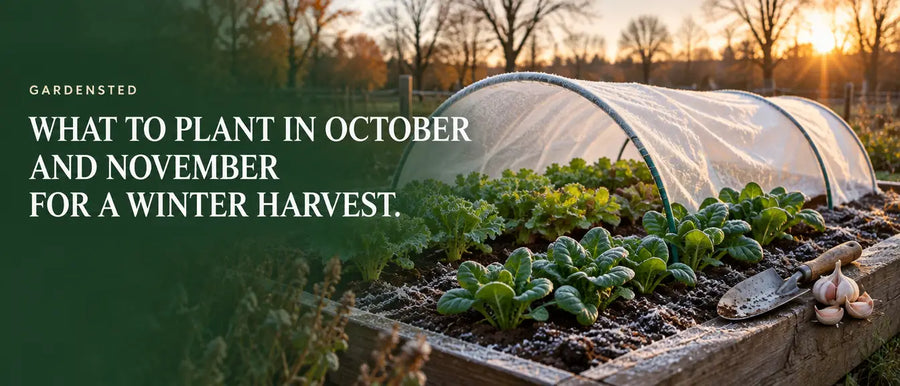
Plastic traps solar heat much more efficiently than fabric. That is useful on cold, bright days and a risk on sunny ones, which is why plastic tunnels need venting and why many gardeners put fabric on first and add plastic later.
How to build a low tunnel
- Pick a bed about 3 to 4 feet wide, in full sun.That width lets you reach the middle from either side, and it matches common cover widths.
- Set the hoops every 4 to 5 feet.Oregon State Extension suggests smaller hoops for short crops like lettuce. Iowa State Extension describes bending 10-foot lengths of EMT conduit over rebar stakes to make strong hoops, and connecting them along the top with strapping or a conduit ridge so they stay upright.
- Anchor both ends.Oregon State Extension recommends a sturdy pipe or pole at each end of the row.
- Drape row cover first.Use a cover wide enough to reach the ground on both sides. West Virginia University Extension suggests a 10 to 14 foot wide blanket for its hoop sizes, held down with clips, soil or weights.
- Add plastic when hard weather arrives.Extension guidance describes a layer of 4 to 6 mil agricultural plastic over the row cover in winter, secured so snow can slide off, and lifted on warm sunny days to ventilate.
- Close and tighten the ends.Tie the plastic to stakes at each end so it is taut, as Eliot Coleman describes in his low-tunnel method, which makes it much more wind and snow resistant.
Oregon State Extension notes that low tunnels have not been evaluated for snow load in Oregon and may not be suitable for winter use there, and West Virginia University Extension warns that heavy snowfall can collapse them. If you get real snow, use sturdy hoops, tighten the plastic, and knock snow off after storms.
Clear polyethylene can overheat in early fall, according to a West Virginia extension column, so do not rush to cover with plastic in October. Fabric first is the safer approach.

Gardzen Garden Hoops for Raised Beds, DIY Kit for Row Cover, 24 Pcs
A fiberglass hoop kit that holds row cover or netting up and away from plants. It suits low, short tunnels over a raised bed, and the same hoops can carry insect netting or shade cloth in other seasons. Kits like this are light duty, so for heavy snow you will want the sturdier conduit hoops described above. Check the listing for hoop height and the number of sections per hoop before you order.
View on Amazon →If you are building raised beds with tunnels in mind, our guide to elevated metal raised beds covers bed options that are easy to hoop.
Planning which crops go under cover, and where? The Vegetable Garden Master System has a frost-date worksheet, 12 ready-made bed layouts and one-page guides for 25 crops, in a 149-page printable planner.
See the planner →Cold Frames
A cold frame is a bottomless box with a clear lid, set on the soil. The New York Botanical Garden describes it as a box set in a garden bed, usually with a glass or clear plastic top, and its plan notes that tall crops will not fit with the lid closed. That limits it to short crops, which is exactly what winter salads and herbs are.

3Wooden Cold Frame
Missouri Extension says the walls are usually 8 to 16 inches high with a glazing of glass, fiberglass, polycarbonate or plastic film, and warns against creosote or penta-treated wood because the preservatives are toxic to plants. Clemson Extension also recommends untreated, rot-resistant wood for the base. Fairfax master gardeners suggest sinking the frame into the ground so the soil insulates it.
Setting up and running a cold frame
- Site it south-facing and sheltered. The lid should angle toward the sun, with a windbreak on the north side that does not shade it.
- Add insulation for cold snaps. Nebraska Extension suggests bales of straw or hay around the outside of the frame. Missouri Extension says a mat or blanket over the lid on cold nights adds only a few degrees, but a few degrees can matter.
- Water by hand. Plants inside get no rain. Clemson Extension says to keep the soil moist but not soggy, and Nebraska Extension notes that ventilation also helps balance soil moisture and reduce humidity.
- Add a row cover inside. Fairfax master gardeners suggest a floating row cover over the plants under the frame for extra protection in a cold spell.
- Use it year-round. The same box hardens off seedlings in spring, according to NYBG, which is when you will be glad you built it.
You can build one from salvaged windows and untreated lumber, or buy a ready-made unit. A ready-made option is below. Note that it is a raised bed with a pitched polycarbonate roof, closer to a mini greenhouse than a low, traditional frame, so it suits short and medium crops.

Outsunny Raised Garden Bed with Polycarbonate Greenhouse (Cold Frame), 48 x 24 x 32 in
A wooden, open-bottom raised bed with an openable polycarbonate roof, listed in Amazon's cold frame category. The listing describes the roof as openable for ventilation and gives overall dimensions of about 48 by 24 by 32 inches. It is a compact unit for a patio or a sunny corner rather than a long bed, and polycarbonate roofing does not shatter the way glass can. As with any cold frame, plan to open it on sunny days.
View on Amazon →Layering for the Coldest Months
The most useful trick in winter growing is to stack covers. Eliot Coleman, who farms in Maine, described a double-covered low tunnel in a talk at the Common Ground Country Fair that was written up by the Maine Organic Farmers and Gardeners Association. He sows hardy crops around October 1, covers the beds right away with row cover on hoops, and in mid-November sets greenhouse plastic over the top. The delayed plastic keeps the air and soil from getting too hot early on, and he suggested trying not to let the temperature go over 80°F. The plastic also protects the fabric from snow, which would tear it.

University of Massachusetts Extension research found that a heavy inner row cover (1.25 oz per square yard) with an outer layer of 0.6 mil infrared greenhouse plastic gave more protection from cold than row cover with perforated plastic, or two layers of row cover. It also noted that removing the plastic and leaving the fabric gives lighter protection when the weather eases. In other words, the layers can be added and removed as the weather changes.
You will see claims in gardening media that each layer is worth about one and a half hardiness zones. That is a rule of thumb, not a measured result, and real gains vary with your weather, so use a thermometer rather than relying on it.
A cheap min-max thermometer placed under the cover tells you how cold it really got overnight and how hot it got by afternoon. Those two numbers decide when to add a layer and when to open one.
Ventilation: The Part That Kills Crops
Cold is the obvious risk. Heat is the one people forget. Clear plastic and glass trap a lot of solar heat, even in winter, and plants that tolerate frost can wilt or bolt when the air under a cover climbs well above what they like. A gardening writer's account of low tunnels in Iowa describes spinach that survived frost but wilted when temperatures passed about 60°F on sunny winter days without venting. Treat that as a single report, but it matches extension advice on cold frames.
| Cover | When to vent | How | Source |
|---|---|---|---|
| Cold frame | Clear, sunny days when outside air is above about 45°F; keep the inside below about 60°F | Raise the lid partly and prop it; close it before evening | Nebraska Extension; Clemson Extension |
| Plastic low tunnel | On sunny days when it warms up, and when humidity builds | Lift one side or open the ends; roll up the sides | West Virginia University Extension; Coleman |
| Fabric row cover | Rarely, since it breathes | Remove in mild weather if you want maximum light | Extension and manufacturer guidance |
Venting thresholds vary by source because they were written for different crops and climates. The New York Botanical Garden aims for about 70°F inside a cold frame and says little to no venting is needed from about November to mid-February in its area, while Clemson Extension wants the frame under 60°F. The reliable pattern is simple: crack the lid on any bright day when the air outside is above roughly 45°F, and close it before the sun drops.

Moisture is the other half of the problem. USDA Natural Resources Conservation Service guidance on low tunnels in Alaska notes that condensation can accumulate and cause plants to rot if they touch the plastic. Keep foliage clear of the cover, and give the tunnel some air on damp days as well as warm ones.

Bayliss XL Autovent Automatic Greenhouse Vent Opener
If you cannot be there to open the lid, a wax-cylinder vent opener does it for you: the wax expands as it warms, pushing a piston that lifts the lid, and a spring closes it as it cools. The listing describes it as solar powered and made for greenhouse windows, and the maker's UK retailer says it lifts a vent up to about 5.5 kg. Check that your lid is light enough. For a traditional cold frame, Johnny's Selected Seeds sells a Univent opener that opens between 60 and 77°F and lifts up to 15 lb, though we could not confirm an Amazon listing for it.
View on Amazon →What to Grow Under Cover
Protected beds do best with crops that already like the cold. Oregon State Extension lists spinach, kale, collards, cabbage, broccoli, Brussels sprouts, arugula, mustard greens, radish, turnip and corn salad among vegetables that can withstand heavy frost, and beets, carrots, lettuce, chard and parsnip among those that tolerate light frost. Under cover, the semi-hardy group becomes much more reliable. For full profiles of the hardiest crops, see our cold-hardy vegetables guide.
| Crop | Best structure | Notes |
|---|---|---|
| Spinach | Low tunnel, cold frame | Iowa State Extension says spinach can be carried through winter under a poly low tunnel. Johnny's advises sowing 35 to 50 days before the dark period begins. |
| Lettuce | Cold frame, low tunnel | Choose cold-tolerant varieties; UConn extension names 'Winter Density', 'Red Oak Leaf' and 'Rouge d'Hiver'. |
| Kale and collards | Row cover, low tunnel | Hardy on their own; cover protects leaf quality in wind and hard freezes. |
| Mizuna, tatsoi, arugula, mustards | Low tunnel, cold frame | Johnny's says these regrow and can be cut multiple times during the dark period. |
| Carrots and radishes | Row cover with mulch | Roots sit insulated in the soil; cover protects the tops. |
| Cabbage family seedlings | Cold frame | Nebraska Extension says cabbage-family plants prefer cool conditions, which suits a frame. |

Harvesting under cover is a small ritual. Open the cover, wait for leaves to thaw, pick the outer leaves and leave the growing center, and close it again. If you want to compare other season-extension options, our backyard greenhouse ideas cover the next step up from the structures here.
A Simple Winter Routine
- Check the forecast each afternoon, and the thermometer each morning
- Vent cold frames and plastic tunnels on bright days; close before evening
- Keep foliage off the plastic to avoid rot and cold spots
- Water sparingly and only on mild days, in the morning
- Check anchors after wind and clear snow after storms
- Harvest after leaves thaw, picking outer leaves first
- Remove or loosen covers as spring approaches, starting with venting
Common Mistakes
- Covering too early with plastic. Fabric first, plastic when hard weather arrives. Early plastic overheats.
- Forgetting to vent. A clear cover on a sunny day can become a hot box. Crack it open before you leave for work.
- Letting fabric or plastic touch the plants. Frost forms and moisture collects where cover meets leaves. Use hoops or stakes.
- Leaving gaps at the edges. Wind gets under loose covers and strips the heat. Weigh the edges all the way around.
- Ignoring snow load. Fabric tears and light hoops fold. Add plastic, tighten it, and knock snow off.
- Overwatering. Plants grow slowly in winter and use little water. Soggy soil and humid air invite rot.
- Expecting growth, not survival. Covers keep hardy plants alive and in good shape. They do not recreate summer.
US and UK Differences
In the UK, the vocabulary is different but the ideas are the same. The RHS describes cloches as low continuous tunnels of flexible plastic that protect overwintered and early vegetables, and notes that gardeners often combine cloches with fleece and insect-proof mesh. Fleece and mini polytunnels are the usual tools, and a cold frame is a standard allotment fixture. The RHS says cloches are less effective than fleece or mesh at excluding pests but do keep birds off, and its guidance elsewhere flags pigeons and slugs as the main winter pests, so netting and slug control belong in the plan. Johnny's Persephone period is calculated for Maine, and most of the UK sits further north, so the slow-growth period is likely to start earlier and last longer. A day-length chart for your location will give the real dates.
In the US, the picture depends on your winter. In mild areas, row cover and cold frames may be all you need to harvest greens most of the winter. Where the ground freezes and snow falls, low tunnels need sturdier hoops and plastic, and cold frames are best for small salad plantings. Check your first and last frost dates with your local extension office, and for more on the cold-snap side, see our guide to protecting your garden from the first frost.
FAQ
Can I grow vegetables in winter without a greenhouse?
Yes, with hardy crops and a simple cover. Cold frames, low tunnels and row covers all extend the harvest without a greenhouse, though they protect rather than heat, so choose crops that tolerate cold.
Which is better, a cold frame or a low tunnel?
A low tunnel is better for long beds because one set of hoops covers the whole row. A cold frame is better for a small patch of salad greens or seedlings, and it is easier to pick from. Many gardeners use both.
How much warmer is it under a cold frame or row cover?
University of Missouri Extension says a cold frame is generally not more than 5 to 10°F warmer than outside air. Row cover manufacturers claim about 4°F for a lightweight fabric up to 8°F or more for the heaviest. Real results depend on weather, wind and sun.
Can I put plastic directly on the plants?
It is better not to. Plastic touching foliage can cause cold damage and rot from trapped moisture. Support it on hoops or stakes so there is air between the cover and the leaves.
Will snow crush a low tunnel?
It can. Oregon State Extension says low tunnels have not been evaluated for snow load in Oregon, and West Virginia University Extension warns that heavy snow can collapse them. Use sturdy hoops, keep plastic tight so snow slides off, and brush snow away after storms.
When should I take the covers off in spring?
Start by venting on sunny days, then remove plastic first once the fabric alone is protection enough. Coleman describes ventilating his tunnels in spring and taking off the plastic layers around late March in Maine. Your date will depend on your last frost.
Final Takeaway
If you want one plan, make it this: set up hooped row cover over your hardy crops now, add clear plastic when hard freezes arrive, and put a cold frame over your salad greens and herbs. Vent on sunny days, keep leaves off the cover, and use a thermometer to see what is really happening. None of these will make a summer garden in January, but together they keep a steady supply of hardy greens within reach of the kitchen. For specifics on your own climate, your local extension office can give you first and last frost dates.
Turn these ideas into a plan for your own beds
Covers protect a garden. A plan decides what goes under them. The Vegetable Garden Master System puts your frost dates, bed layouts and season calendar on paper.
- 12 ready-made bed layouts to copy or adapt
- A frost-date worksheet and planting calendars
- One-page guides for 25 crops: spacing, depth, days to maturity


149-page printable PDF, instant download. Crop guides cover 25 vegetables; kale, garlic and herbs are not in this edition.
Product Summary
Every product below also appears in the article above. We have not tested any of them, and the ASINs should be checked on Amazon before you buy.
| Product | Best For | Why It Fits This Article | Key Feature to Look For | Amazon |
|---|---|---|---|---|
| Agfabric 6 ft x 25 ft, 0.9 oz Frost Blanket | Covering beds and rows | Medium-weight row cover for hoops or floating use | Width that fits your bed and hoops | View on Amazon |
| Gardzen Garden Hoops, 24 Pcs | Low tunnels over raised beds | Holds fabric off the plants | Hoop height and sections per hoop | View on Amazon |
| Outsunny Raised Bed with Polycarbonate Greenhouse | Small cold-frame growing on a patio or corner | A ready-made, openable, sun-trapping unit | Openable roof and overall height | View on Amazon |
| Bayliss XL Autovent | Automatic venting of a lid or window | Prevents overheating when you cannot open the lid | Lift rating compared with your lid weight | View on Amazon |

0 comments