

A winter vegetable garden is decided in late summer, not in winter. By the time the days get short, every plant you will harvest from should already be close to full size, because growth nearly stops. This guide gives you a simple bed layout, a way to work out your own last sowing dates, and a planting calendar you can adapt to any climate.
Most winter garden advice says "plant hardy crops" and stops there. That leaves out the part that actually causes problems: timing. A kale plant sown on time and a kale plant sown six weeks late can sit in the same bed, face the same frost, and give completely different harvests. The difference is how big each one was when the light faded.
What You'll Learn
- Why day length, not temperature, sets your winter planting deadline
- How to count back from your own darkest weeks to find last sowing dates
- A 4 x 8 ft winter raised bed layout with crop zones and plant counts
- A season-by-season planting calendar from midsummer to late winter
- How to protect, harvest and plan for spring without wasting plants
The Short Version
Work out when your days drop below about 10 hours (roughly late October at 51°N, early November at 40°N, late November at 34°N). Count back from that date by each crop's days to maturity plus about 14 days for slower fall growth. That is your last sowing date. Put the tall, slow brassicas at the back of the bed, garlic and roots in the middle, and quick greens at the front where you can reach and cover them.
If it is already October, garlic is the main thing to plant now. For everything else, use this guide to manage what is already growing and to plan next summer's sowings.
Why Day Length Sets the Calendar
Gardeners tend to plan winter around frost. Frost matters, but light matters more. NC State Extension points out that plant growth nearly stops when daylight falls below about 10 hours. Eliot Coleman, the market gardener who popularized year-round growing, calls this stretch the Persephone period. During it, a crop in the ground mostly holds what it has. You can pick from it, but it will not grow much more.

The practical consequence is a deadline. Johnny's Selected Seeds suggests planning crops to be about 75 percent mature when the Persephone period begins, so that you are harvesting from a standing crop rather than waiting on one that has stalled. Nebraska Extension makes a related point: add 10 to 14 days to a crop's listed days to maturity to allow for slower growth as the weather cools.
When does it start where you live? The table below shows our own calculation of when the day, sunrise to sunset, drops below 10 hours and when it climbs back above it, at four latitudes. It uses standard daylight formulas and ignores twilight, so treat the dates as good to within about a week. NC State puts the end of the period in early February for the southeastern US, which fits the 40°N row better than the 34°N one, so your own latitude and local sources win over any table.
| Latitude | Roughly where | Days fall below 10 hours | Days climb back above 10 hours |
|---|---|---|---|
| 34°N | Atlanta, Dallas area | About Nov 24 | About Jan 17 |
| 40°N | Philadelphia, Denver area | About Nov 8 | About Feb 3 |
| 45°N | Minneapolis, Portland (OR) area | About Oct 30 | About Feb 12 |
| 51°N | London, southern England | About Oct 22 | About Feb 20 |
Notice how long the dark stretch is at higher latitudes: about four months at 51°N against about two at 34°N. That is why a UK or northern US garden has to sow so much earlier than a southern one, even though both can grow the same crops.
How to Count Back to Your Sowing Dates
The method is simple. Take the date your days fall below 10 hours, then subtract the crop's days to maturity and about 14 days for slower fall growth. Frost-tender crops that need warm weather to finish need extra margin, but this list is all hardy, so one fortnight is a sensible allowance.
Here is a worked example for kale at 40°N. Days to maturity for kale run from 40 to 65 days according to University of Minnesota Extension; we use 60 to be cautious. The darkness begins about November 8. Count back 60 days plus 14 days, which is 74 days, and you land on about August 26. Sow after that and the plants will still be small when growth stops.
The table applies the same arithmetic to seven winter crops. The days-to-maturity figures are the ones we assumed, taken from University of Minnesota Extension ranges and the Old Farmer's Almanac planting tables. Seed packets for your variety are better, so swap in their numbers.
| Crop | Days to maturity we assumed | Latest sowing at 34°N | Latest sowing at 40°N | Latest sowing at 51°N |
|---|---|---|---|---|
| Brussels sprouts | 100 | About Aug 2 | About Jul 17 | About Jun 30 |
| Winter cabbage | 90 | About Aug 12 | About Jul 27 | About Jul 10 |
| Carrots | 70 | About Sep 1 | About Aug 16 | About Jul 30 |
| Broccoli | 65 | About Sep 6 | About Aug 21 | About Aug 4 |
| Kale | 60 | About Sep 11 | About Aug 26 | About Aug 9 |
| Turnips | 55 | About Sep 16 | About Aug 31 | About Aug 14 |
| Spinach | 45 | About Sep 26 | About Sep 10 | About Aug 24 |
These dates are our own editorial arithmetic, not extension recommendations. They assume the crop should be full size when days drop below 10 hours. You can sow later if you are happy with a smaller, baby-leaf or early-spring harvest, which is covered in the calendar below.
Garlic and sprouting broccoli break this pattern. Garlic goes in during fall and is harvested the next summer, so it does not follow the count-back rule. Sprouting broccoli is sown in late spring or early summer and cropped the following late winter, according to the RHS. Plan them as separate lines in the bed.

AcuRite Wireless Indoor/Outdoor Thermometer (model 00782A2)
A wireless sensor outdoors and a display indoors, so you can read the overnight low from the kitchen before deciding whether to cover the bed. Place the sensor in shade near the crops, not against a sun-warmed wall, and use lithium batteries in very cold weather as the maker's manual advises for deep freezes.
View on Amazon →A 4 x 8 ft Winter Bed Layout
A 4 x 8 ft raised bed is the most common size, and it divides neatly into four zones of 4 x 2 ft. The layout below runs from the north end to the south end. Tall plants sit at the north so they do not shade the others, which matters more in winter when the sun is low. Fast leafy crops sit at the south end where you can reach them, lift a cover over them, and pick them often.
This is an editorial suggestion, not a tested plan. Spacings follow standard extension and seed-packet guidance, widened slightly because soft, crowded growth is more easily damaged by cold.

| Zone (north to south) | Crop | Spacing | How many | Why it sits here |
|---|---|---|---|---|
| 1. North end, 4 x 2 ft | Kale (or collards) | About 18 in apart, staggered | 4 plants | Tallest plants; they shelter the rest and stand through winter |
| 2. 4 x 2 ft | Garlic | 6 in grid | Up to 32 cloves | Planted in fall, left alone until summer, mulched deeply |
| 3. 4 x 2 ft | Carrots and turnips | Carrots about 2 in apart; turnips about 4 in | Roughly 2 short rows of each | Stay in the ground under mulch and are dug as needed |
| 4. South end, 4 x 2 ft | Spinach and loose-leaf lettuce | About 5 to 6 in apart | Up to about 30 plants | Quick leaves you pick often; easiest to cover and reach |
Check on the arithmetic: a 4 ft bed is 48 in wide and a 2 ft zone is 24 in deep. At a 6 in grid that gives 8 plants across and 4 deep, so 32 positions. Spinach spaced 5 in apart fits slightly more, but we have kept the count conservative.
Leave your paths wide enough to kneel in and keep a hoop set ready for the south end of the bed. If you grow in the ground rather than a raised bed, use the same zone order but run each crop as one or two long rows across the bed, so a single row cover covers a whole crop. Short on space? Our guide to the small-space winter vegetable garden covers a 4 x 4 ft bed and containers.
Want this layout drawn for your own bed? The Vegetable Garden Master System has 12 ready-made bed layouts and a frost-date worksheet, in a 149-page printable planner.
See the planner →The Winter Planting Calendar
Rather than give dates that only suit one region, the calendar below is relative to the day your days fall below 10 hours. Call that day "D". Put your own D into a calendar, then subtract.
| When | What to do | Crops |
|---|---|---|
| About 14 to 17 weeks before D | Sow the longest-season crops, ideally in a nursery bed or seed trays | Brussels sprouts, winter cabbage |
| About 10 to 12 weeks before D | Sow brassicas and roots in the bed or transplant seedlings | Broccoli, kale, collards, carrots |
| About 8 to 10 weeks before D | Sow the quick roots and chard; thin and weed established plantings | Turnips, chard, beets |
| About 6 to 7 weeks before D | Last sowing of fast greens in the open bed | Spinach, lettuce, mustard greens |
| Around D, in October or early November | Plant garlic; mulch roots once nights stay cold; put hoops and row cover on the south end | Garlic, all roots |
| The dark weeks (D to about 10 weeks later) | Harvest lightly from outer leaves and dig roots as needed; do not feed; water only if dry | Kale, leeks, spinach, roots |
| When days climb back above 10 hours | Growth resumes; pick sprouting broccoli and spring greens; sow the first hardy crops under cover | Spinach, lettuce, radish, peas under cover |
The week ranges are our own translation of the count-back table and the 14-day fall allowance. Local frost dates and the variety on your seed packet should override them.

What the calendar looks like in practice
Roots are the most forgiving plan. Michigan State University Extension says carrots, turnips, beets, rutabagas and parsnips store well in the garden until just before the ground freezes. Mulch the tops with straw or leaves so the soil stays workable and the roots stay protected. NC State recommends 4 or more inches of mulch over root crops before a hard freeze.

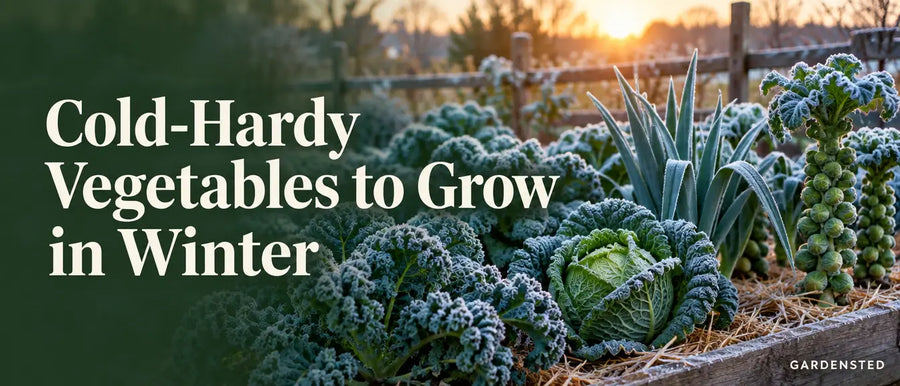
Garlic is the exception to the count-back rule. Colorado State Extension in Pueblo gives early September through the end of October as the planting window while the soil is warm, and notes that garlic planted in October is ready in late June to early July. Tilth Alliance recommends covering the bed with 3 to 4 inches of fall leaves or straw. For more on which crops stand up to cold, see our guide to cold-hardy vegetables to grow in winter.
Protecting the Bed
The hardiest crops need very little. The RHS says leeks need no frost protection, and Brussels sprouts and kale stand outdoors through harsh weather. Cover is for borderline crops and borderline nights: chard, spinach, heading broccoli, lettuce and anything planted late. Put the covers over the south end of the bed, which is where the tender leaves are.

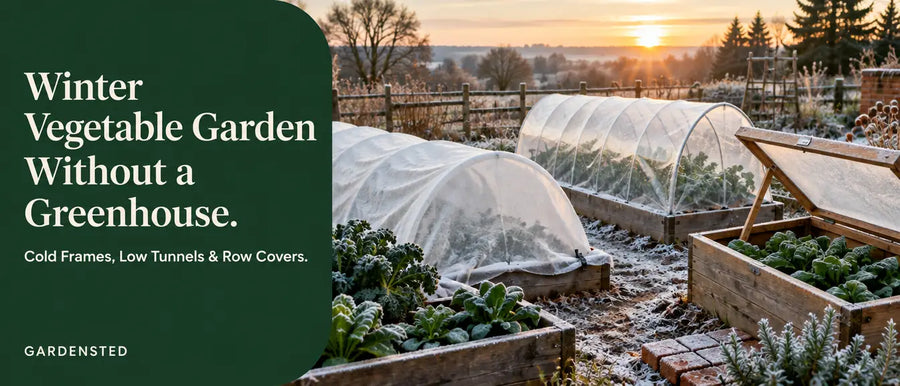
Purdue Extension lists the basic options as mulch for small beds, blankets or floating row covers over rows, and cloches or plastic walls of water for a pricier but very effective solution. The simplest setup for a raised bed is a floating row cover over a set of hoops. The hoops keep fabric off the leaves, which matters because fabric touching foliage can pass cold to it. Row-cover listings typically quote only a few degrees of extra protection, with heavier fabric giving more but letting in less light, so match the weight to how cold your winter really is.

Agfabric Floating Row Cover
Lightweight fabric that drapes over a bed or hoops to blunt wind and frost. It sits on top of the plants and is easy to lift for harvesting. Weights and sizes vary between listings, so check the weight and dimensions against your bed before buying.
View on Amazon →
Gardzen Garden Hoops
Hoops hold row cover clear of the leaves to make a mini tunnel over a raised bed. Check that the hoop width and length fit your bed before you order, and weight the fabric edges down so wind cannot lift them.
View on Amazon →
If you want more protection than fabric gives, a cold frame is the next step, and our guide to winter vegetable gardening without a greenhouse covers the options. For what to do before the first hard frost arrives, see how to protect your garden from the first frost.
Harvesting Through Winter
In winter plants take far longer to replace what you cut. Harvest the outer leaves of kale, chard, spinach and lettuce a few at a time, leave the growing center, and take a little from each plant rather than stripping one. MSU Extension notes that cold converts starches to sugars in kale, collards and chard, so winter leaves are noticeably less bitter than summer ones. Wait until frozen leaves have thawed before picking, because they bruise easily.


Fiskars Micro-Tip Garden Snips
Small, precise tips make clean cuts among crowded winter greens without tugging the root. They are not meant for woody stems, so use proper pruners for those. Keep a pair by the door, because winter picking is a few leaves at a time.
View on Amazon →If You Are Starting in October
If you are reading this in October, most of the count-back dates have passed. That is fine. Garlic can go in now, and in mild regions spinach and hardy greens can still be sown in early October: extension guidance for Virginia's Zone 7a says spinach can be sown in the first part of the month. Young transplants of kale, chard and lettuce are the other realistic option.
Seeds sown very late may germinate but grow too slowly to harvest before the short days, so they may sit as small plants until spring. That is not a failure. A bed of small, healthy plants often gives an early spring harvest. Use this winter to work out your own dates, then put them in your calendar for next summer.
Common Layout and Timing Mistakes
- Counting from the first frost instead of the dark weeks. Frost date is the wrong anchor. Day length decides when growth stops.
- Putting tall crops at the south end. Kale and Brussels sprouts shade everything behind them when the sun is low. Keep them at the north end.
- Skipping the 14-day allowance. Days to maturity on a packet assume summer growth. Fall growth is slower, so add 10 to 14 days, as Nebraska Extension suggests.
- Crowding plants. Packed leaves hold moisture and invite disease when air barely moves. Give winter crops a little extra room.
- Mulching after the freeze. If you want to dig roots in January, mulch before the ground freezes, not after.
- Forgetting netting and slug control. The RHS flags pigeons and slugs as the main winter pests. Cold often gets blamed for bird damage.
Winter Garden Checklist
- Find the date your days drop below 10 hours and write it in your calendar
- Count back each crop's days to maturity plus about 14 days
- Keep kale, collards and other tall crops at the north end
- Plant garlic in fall and cover with 3 to 4 inches of straw or leaves
- Mulch roots with 4 or more inches before a hard freeze
- Keep hoops and row cover ready for the south end of the bed
- Pick outer leaves only, and wait for frozen leaves to thaw
- Do not feed plants in winter
FAQ
When should I plant a winter vegetable garden?
Most winter crops are sown in late summer to early fall, counting back from the date your days drop below about 10 hours. At 40°N that works out to roughly mid-July for the slowest crops, such as Brussels sprouts, and around September 10 for spinach. Garlic is planted in fall.
How do I find my Persephone dates?
Look up sunrise and sunset times for your location and find the dates when the difference falls under 10 hours in fall and rises back above it in late winter. The table in this guide gives rough dates for four latitudes. Local weather or extension sources can give more precise ones.
What is the best layout for a winter raised bed?
Put tall crops such as kale at the north end, garlic and roots in the middle, and quick leafy greens at the south end, where they are easy to reach and cover. Plant in blocks rather than mixed rows, so one cover protects a whole crop.
Can I plant vegetables in November?
Garlic, yes, in most climates. Other seeds sown that late usually stall until spring in cold regions. In mild climates some hardy greens can still be sown, but the harvest will be small.
Do I need to cover hardy crops?
Not usually. The RHS says leeks need no frost protection, and Brussels sprouts and kale stand through winter. Cover chard, spinach, lettuce, heading broccoli and new seedlings, and use mulch for roots and garlic.
Do winter vegetables need fertilizer?
Generally no. The RHS advises against winter feeding, and Territorial Seed suggests not feeding winter crops heavily, because soft, fast growth is more easily damaged by cold.
Final Takeaway
A winter garden is won by timing and layout, not by gadgets. Find the date your days drop below 10 hours, count back from it for each crop, and plant in blocks with tall crops at the north end and quick greens at the south. Plant garlic now, mulch the roots before the ground freezes, and keep a row cover ready for the borderline nights. Then put your own count-back dates in next year's calendar. Your local extension office can give you first and last frost dates for your area.
Turn this winter plan into a real bed map
Knowing the count-back dates is one thing. Fitting them to your own beds, frost dates and seed packets is where most plans fall apart. The Vegetable Garden Master System puts the whole season on paper.
- 12 ready-made bed layouts to copy or adapt
- A frost-date worksheet and planting calendars
- One-page guides for 25 crops: spacing, depth, days to maturity


149-page printable PDF, instant download. Crop guides cover 25 vegetables; kale, garlic and herbs are not in this edition.
Product Summary
Every product below also appears in the article above. We have not tested any of them.
| Product | Best For | Why It Fits | Key Feature to Look For | Amazon |
|---|---|---|---|---|
| AcuRite Wireless Indoor/Outdoor Thermometer (00782A2) | Checking overnight lows | Tells you when the south end of the bed needs cover | Wireless outdoor sensor, indoor display | View on Amazon |
| Agfabric Floating Row Cover | Frost and wind on beds | Lightweight cover for borderline nights | Fabric weight and size that match your bed | View on Amazon |
| Gardzen Garden Hoops | Raised-bed tunnels | Keeps fabric off the leaves | Hoop width and length that fit your bed | View on Amazon |
| Fiskars Micro-Tip Garden Snips | Leaf-by-leaf harvests | Clean cuts on kale, chard and spinach | Sharp, precise tips | View on Amazon |

0 comments